City Council Approves Next Year’s Budget
By Ellen Putnam
Photo Credit: Nancy Clover
On Monday night, the City Council approved a budget of $107.5 million for the City of Melrose and the Melrose Public Schools for Fiscal Year 2026 (FY26), which starts in July. This concludes a months-long process that began when the School Committee developed the $47.6 million school budget in collaboration with the superintendent. The City Council thenvoted on each department’s budget individually, and finally approved the overall budget this week.
Even though the FY26 budget is almost $3.5 million larger than the FY25 budget was, it incorporates $6.6 million in service cuts - $4 million within the school budget and $2.6 million in the rest of the city budget. This is due to costs rising faster than revenue in a number of budget areas, many of which are legal or contractual mandates for the city.
On the revenue side, all municipalities in Massachusetts are constrained by Proposition 2½, a 1980 ballot initiative that prohibits cities and towns from raising the total amount of property taxes collected by more than 2.5% each year, plus an amount calculated to represent new growth (Melrose’s new growth for next year will be $500,000).
The limit that Proposition 2½ sets on the total amount of property taxes the city can collect means that Melrose’s tax rate - the amount paid per $1,000 of assessed property value - has actually decreased over the last decade. At the same time, rising property values mean that many property owners are paying more in property taxes overall. 91% of Melrose’s property tax base is residential (compared to Burlington, for example, whose tax base is 37% residential).
Cities and towns can “override” the 2.5% cap through a citywide vote, which creates a new levy limit that the following year’s taxes will then be based on. In June of 2024, Melrose voters rejected a $7.7 million override proposal, 55% to 45%.
The City Council voted earlier this month to place three “tiered” override questions on the ballot in this November’s municipal election, for $13.5 million, $11.9 million, or $9.3 million. For tiered override questions, only one override amount, if any, would go into effect, and if more than one amount received more than 50% of the vote, the highest dollar amount that received a majority would go into effect. (See Figure A for examples of how this would work.)
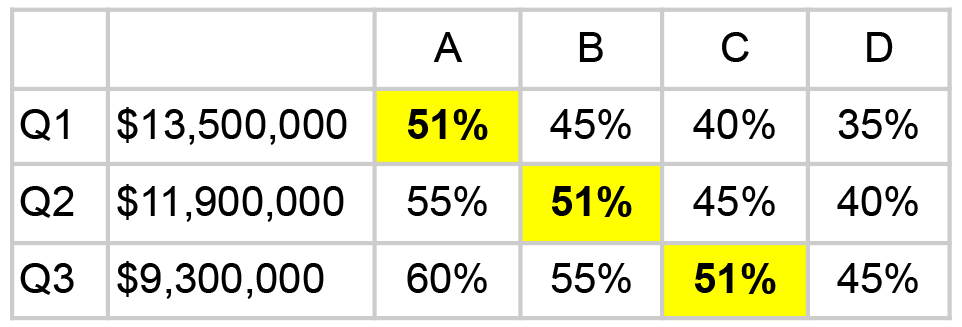
Figure A: The image above shows percentages of "Yes" votes for each override question in four example scenarios, A through D. The highlighted amount is the winning amount, if any. Note that in each scenario, only one override amount goes into effect.
According to Mayor Jen Grigoraitis, a $9.3 million override would stabilize cuts at FY26 levels for the next three years (including through contract negotiations with all twelve of the city’s unions), and the $11.9 or $13.5 million override amounts would also allow the city to reverse some of the cuts that have been made over the last two years.
In addition to property tax revenue, approximately 20% of the city’s budget comes from state aid, which is a combination of Chapter 70 aid for the schools and Unrestricted General Government Aid. State aid fluctuates: it rose by 10% and 15% in FY23 and FY24, but it increased by less than 5% last year, and it is expected to increase by a similar amount this year, although the final number will not be set until the state budget passes in July.
The city takes in another approximately $7.5 million in local receipts - vehicle excise taxes, meals tax, building permits, and other revenue that can be difficult to predict exactly from year to year. The state’s Division of Local Services (DLS), which advises municipalities on best practices for budgeting, recommends that cities and towns include only some of their local receipts in the budget, due to the variable nature of the revenue.
At the end of a fiscal year, DLS looks at the money left over in the city’s budget, minus any outstanding debts, and certifies that amount as free cash. The process takes several months, so free cash is usually not available for use until the winter or spring of the following fiscal year. (The City Council has just finished appropriating free cash left over from the FY24 budget.)
DLS recommends that municipalities plan to receive five to seven percent of their total budgets in free cash. Melrose’s free cash has hovered around five percent for most of the last decade, although that hasn’t always been the case: in 2006, the city had no free cash left over at the end of the year.
In recent years, Melrose has usually included 70% of local receipts in the budget, which helps boost the amount it will receive in free cash. Last year, Mayor Grigoraitis started including 85% of local receipts in the budget, which means that starting next spring, there is likely to be less free cash to work with. “We’re basically tapping into free cash to be able to better fund what we need to do from an operating standpoint,” City Councilor Robb Stewart noted during the budget process.
In past years, Melrose has used free cash to fill gaps in the city's operating budget. Mayor Grigoraitis intentionally moved away from this practice last year. “It's not just prudent,” she explained, “it also prevents the City from accidentally creating scenarios we often call 'fiscal cliffs.' Paying for salaries or key programs out of free cash can create fiscal cliffs, where important line items are suddenly unable to be funded because of availability in the level of free cash.”
While free cash did not fund ongoing expenses such as salaries this year, budget cuts led to some items from the operating budget being shifted onto free cash, including replacing computers, purchasing protective gear for firefighters, and paying students who work for the Department of Public Works during the summer.
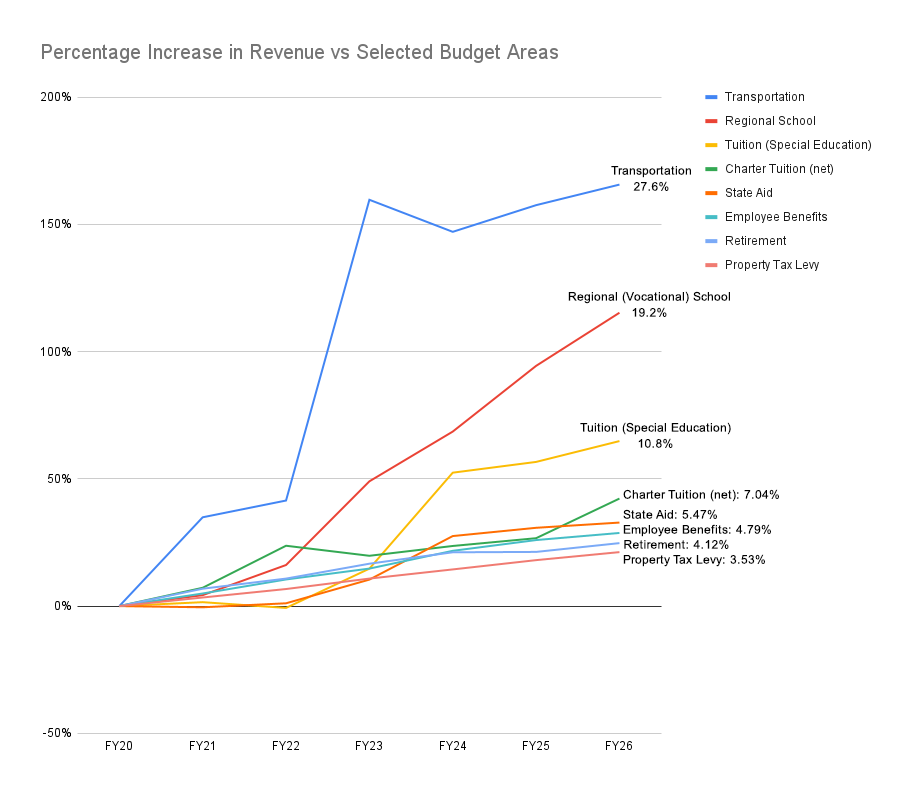
Figure B: Percentage increases in selected budget areas vs revenue (average increase is labeled on each line), FY20-FY26.
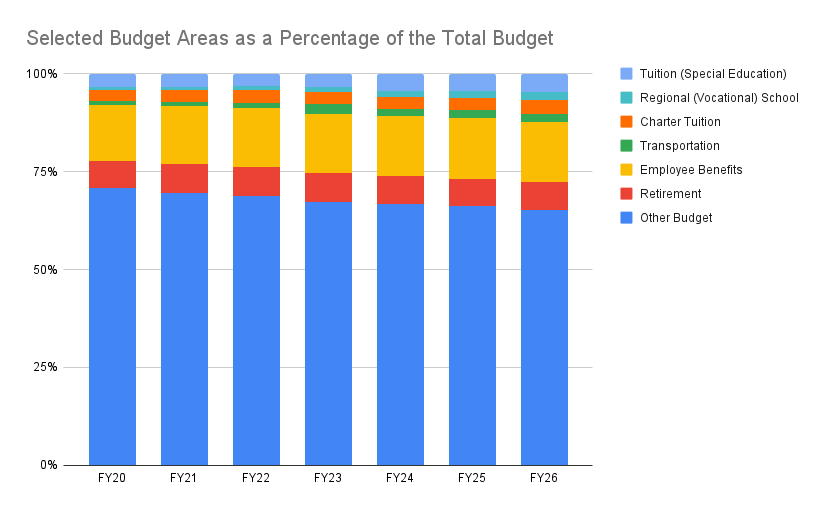
Figure C: The selected budget areas from Figure B as a percentage of the total city budget.
The City of Melrose’s overall budget has risen 3.25% from last year, but a number of expenses have risen significantly more than that.
The city is required by state law to provide health insurance for all employees who work 20 or more hours per week. The Group Insurance Commission, which Melrose contracts with to provide health insurance for its employees, raised healthcare premiums by 12.9% this year.
Pension costs rose by 3.5% this year, and they are expected to keep rising: by 2040, Melrose must fully fund its pension system, with annual costs rising from the current $7.6 million to $13.5 million.
Property insurance on municipal buildings, out-of-district tuition and transportation for students with disabilities, and tuition for students who attend regional vocational schools have also risen significantly in recent years.
And nearly all of the city’s employees are covered by union contracts. “Those contracts are arguably one of the biggest drivers of our budget,” Grigoraitis told the City Council. “I know for folks in the private sector, unions can be something they don’t deal with, but it is the vast majority of our workforce. There’s usually a combination of mandatory cost of living increases as well as some type of longevity increase. And those costs are typically in excess of 2.5%.”
The city is also constrained by a number of legal requirements.
The police and fire departments have minimum staffing requirements for each shift: if too few officers or firefighters are available to work, then other staff must cover those shifts. This can end up costing the city more in overtime and can cause morale issues when employees are not able to go home at the end of their shifts.
The city has cut back hours at the library as much as it can: if the library cuts back too many hours, it risks losing accreditation from the state's Board of Library Commissioners, which would mean that the city would need to pay back the $8 million state grant it was given for renovating the library - with interest.
“The library is a beautiful new facility and we’d like to see it open,” said Grigoraitis, “but the reality is, it’s a million dollar part of our budget, and there are significant financial risks associated with reducing that beyond the few hours that we’ve cut it back for next year.”
Melrose is required by contract to pay over 80% of health insurance premiums for both employees and retirees - “we have a very generous split,” said Grigoraitis. This amount is set by the city’s Public Employee Committee agreement, which all of the city’s unions must agree to.
Even smaller departments like Inspectional Services are driven by state mandates. Department head Albert Talarico, talking about his department’s needs, noted, “These requirements are not city requirements. They’re mandated by the state. There’s no way around them. You need a weights and measures officer. You need a building inspector to do the inspections. You need an electrical inspector. So the choices that the city has are really limited.”
City Councilor Ryan Williams reflected, “In the work I do, we often refer to our money as restricted and unrestricted. And it’s really helpful to understand how a big sum of money can be actually quite limited in its ability to cover costs, because you may have a huge budget, but if it’s highly restricted, it’s very inflexible, and it can be highly committed into certain future costs. And I think we have a lot of that in here.”
The combination of limited revenue and rising costs that the city has relatively little control over has led to service cuts where the city is able to make them, although Grigoraitis expressed concern that if current trends continue, the city may not be able to make more cuts in FY27 and still comply with its legal and contractual obligations.
Read about budget impacts within specific departments:
- The Melrose Public Schools is eliminating 35 positions;
- A number of city departments, including Veterans Services, are seeing reductions;
- The Department of Public Works is eliminating several positions, which will affect road maintenance and trash collection in public spaces;
- The city's ambulance service is being replaced by a private service, and the Melrose Police Department is down two officers;
- Some cuts were made to the Memorial Hall budget, and the City Council discussed the possibility of defunding it entirely.
“Accumulated cuts and reductions over several fiscal years mean that many of our departments don't have positions or services remaining to be cut,” Grigoraitis emphasized. “These departments are approaching a true minimum number of staff to meet the department's responsibilities and legal obligations. Eventually, piecemeal cuts cease to be cost-effective, and the only remaining option without new funding is to eliminate departments entirely.”
Grigoraitis noted that her administration has been working on finding ways to save money, and will continue to do so over the next fiscal year.
While Melrose has gone after grant funding aggressively in the past, Grigoraitis has now asked departments to pull back on grant applications to avoid taking on additional expenses. “We’ve been talking with department heads about how, when we’re going for grant funds, what’s going to be done with those grant funds has to be totally supported by the funds,” said Grigoraitis. “We can’t be taking on hidden costs like pension obligations, health insurance, computers, because there really is no ability to carry that forward.”
This may save the city money in the short-term, but it means the city cannot benefit from state and federal grants, which in the past have covered areas ranging from stormwater mitigation to an adjustment counselor at Melrose High School to purchasing an accessible van for the Council on Aging.
And several departments have had openings for months that they have not filled, to avoid having to lay off staff at the start of FY26. “Obviously, it’s not great humanity to be bringing people into a job not knowing if they’re gonna be able to stick around,” said Grigoraitis, “And we also are very aware that when we lay people off, there are actual monetary costs that the city bears. The unemployment costs go with us.”
Next year, the city will be looking into renegotiating its Public Employee Committee agreement, in an attempt to save some money on health insurance premiums, although any changes will require the approval of all of the city’s unions.
And the city will also be looking at reducing or eliminating smaller expenses, like the city's parking lease at St. Mary’s, and studying how Memorial Hall could become budget-neutral or even a money-maker for the city.
While the city’s budget, with the elimination of over 50 positions and cuts to many services that residents have come to expect, may look dire to some, Mayor Grigoraitis and her administration have aimed to keep some funds available for “a rainier day” - possibly in FY27, if an override does not pass and more cuts are needed, or at any point if potential federal funding cuts impact the city’s finances.
In an attempt to plan for future emergencies, the city has added to its stabilization funds this year, which now total over $10 million. These are effectively the city’s “savings accounts” that can be used for unbudgeted expenses, such as midyear contractual salary increases, sudden capital needs, unexpected increases in special education spending, or lawsuits against the city.
“Although we face another challenging budget cycle here in Melrose,” Grigoraitis said in a statement after the budget was approved, “I remain grateful for the attention and thoughtfulness of our City Council and the diligent work of our department heads and City employees over many long evening meetings this spring. Thank you to everyone who helped make the hard and necessary decisions that produced this balanced budget while preserving as many of our community’s budget priorities as possible.”