Melrose Rail Corridor Development is Driven By State Housing Law
By Ellen Putnam
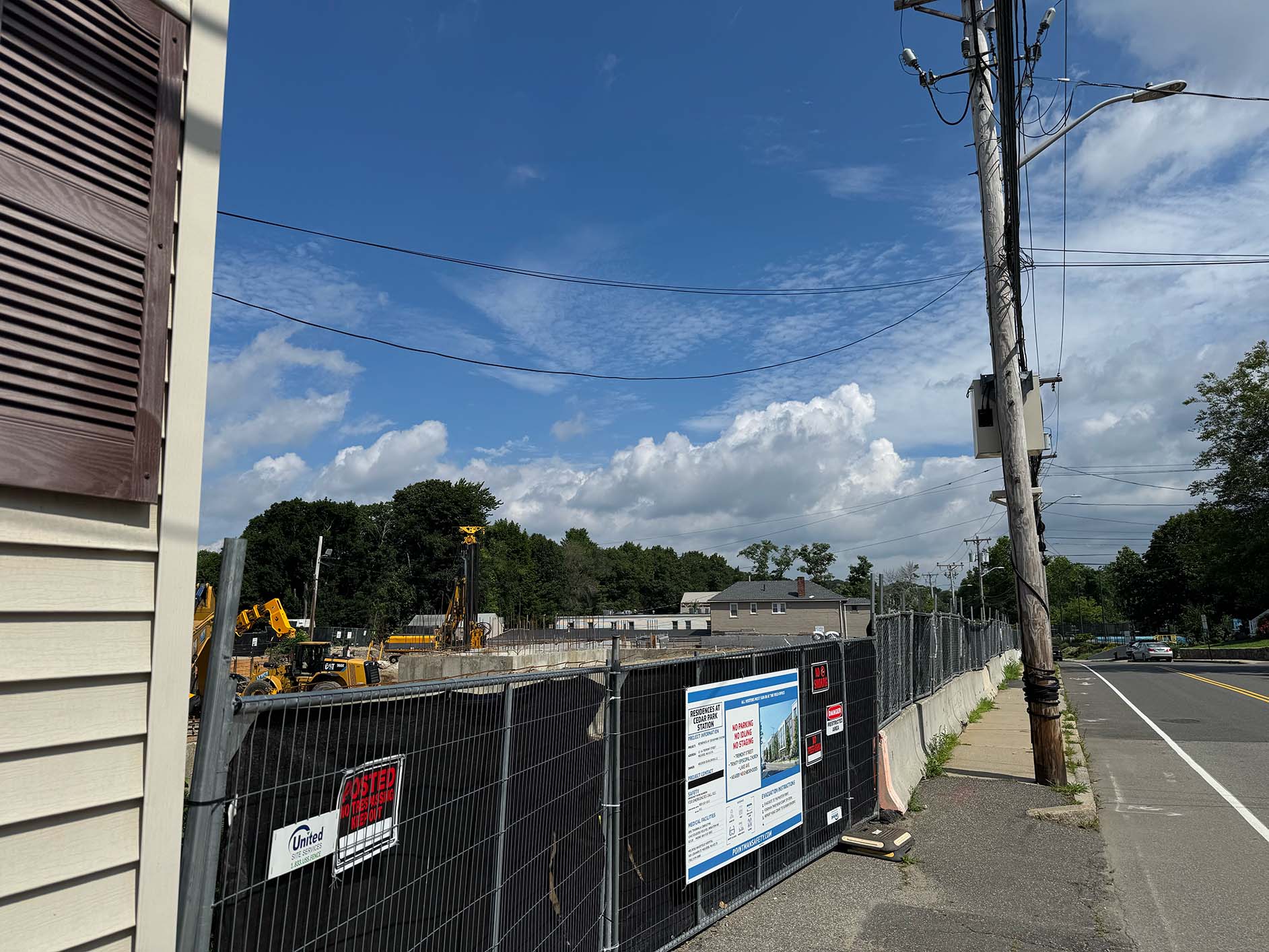
Construction at 14-24 Tremont Street
Melrose residents are likely to soon see more apartment buildings going up along Melrose’s rail corridor, after the city’s Zoning Board of Appeals (ZBA) last week approved one 50-unit building near the Cedar Park commuter rail station and appears likely to approve another 60-unit building near the Melrose Highlands commuter rail station.
The ZBA handles all requests for exemptions from the city’s zoning requirements, which dictate things like the height of a building, how far it must be set back from the street, and even, in some cases, what the outside can look like. Most of Melrose is zoned for single- or two-family houses, but the Rail Corridor Overlay District (RCOD), where much of the recent development has been taking place, does allow for larger multiunit buildings without the need for a zoning appeal.
Due to its proximity to the commuter rail and the availability of larger parcels of land along the tracks (some of which have previously been used for industrial or light-industrial purposes that are now obsolete), the city designated the Rail Corridor Overlay District as an area for development. Many of the proposed sites for development in Melrose's 2022 Housing Production Plan are located in the RCOD.
In addition to zoning appeals, the ZBA also approves permits for construction of residential buildings filed under state housing law Chapter 40B. Chapter 40B, which was passed in 1969, allows developers to bypass local zoning requirements if 20-25% of the units in a development will be marketed as affordable to an individual or family making 80% or less of Area Median Income. The ZBA reviews applications for a comprehensive permit filed under 40B, but if the ZBA rejects a proposal or modifies it too much, the developer can appeal those decisions to the state Housing Appeals Committee, as happened with the Weiss Farm development in Stoneham.
When a municipality reaches the point where 10% of its housing stock is designated as affordable, it achieves what is called “safe harbor status” and is no longer subject to “unfriendly” 40B projects. “We’re really trying to get to 10% so we’re not subject to approving 40Bs we don’t like,” explained City Planner Lori Massa. The city can also achieve temporary safe harbor status by increasing its affordable housing inventory by a specific amount in a year. That number for Melrose is 63 units, which the city achieved last year. This means the city is currently in safe harbor status, although the city needs to continue producing at that rate in order to maintain that status.
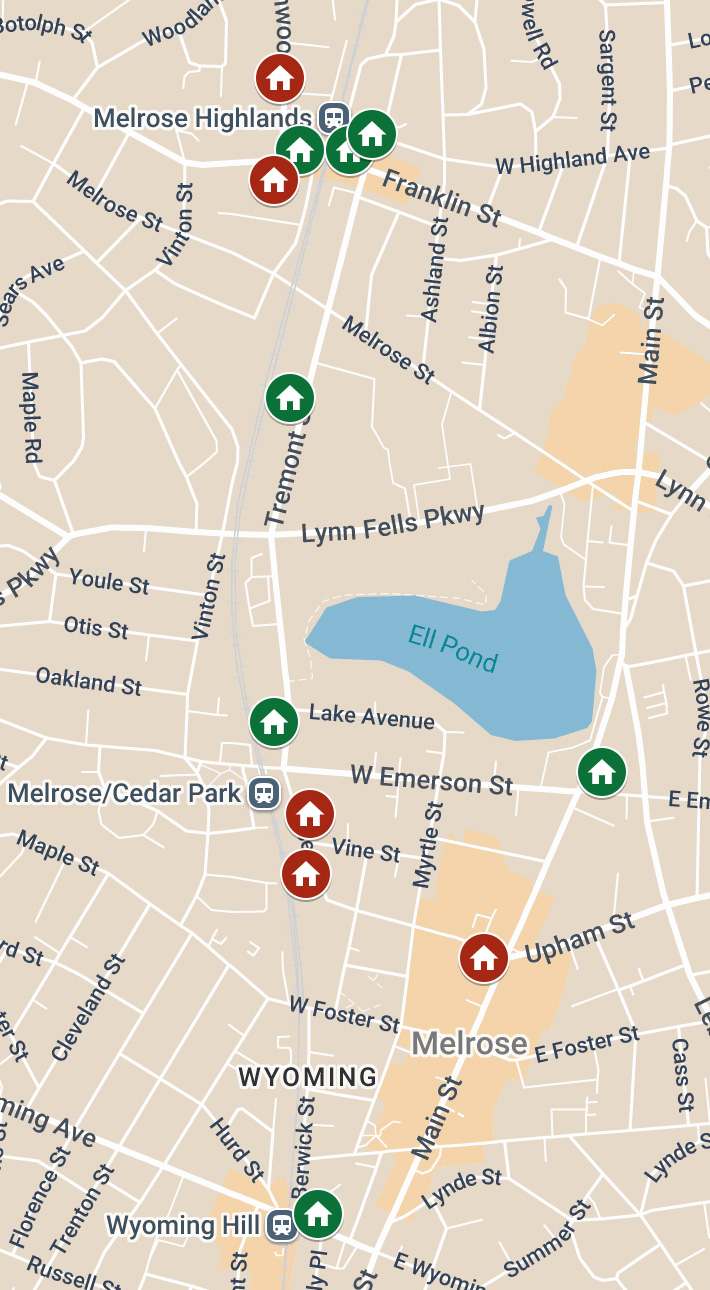
Developments that are under consideration, have been approved, or are currently under construction in Melrose. 40B developments are shown in red, and others are shown in green.
Created Using Google Maps
The ZBA and the city’s Planning Board, which approves site plans for buildings that aren’t filed under 40B, are independent boards staffed by volunteers who are appointed by the mayor and approved by the City Council. They are supported by staff from the city's Office of Planning and Community Development (Planning Department).
“We’re fortunate that this community has been very thoughtful and measured around development,” said Mayor Jen Grigoraitis. “Our Planning Department has led with expertise, and we are fortunate to have Planning Board and ZBA members - all of whom are residents - who volunteer their time and their professional expertise to help shape our community.”
The requirements of Chapter 40B mean that the ZBA and the Planning Board have a number of considerations to take into account when they review a project. “We didn’t think the project at 28 Greenwood Street was a great location, due to the need for blasting and the impact to the neighbors, and potential issues with stormwater management,” explained Massa. “There were a lot of questions, and you can’t really assess the land until after you do the blasting. We pushed back with that one, but the ZBA did need to approve it because, in the end, the state Housing Appeals Committee can just say that the developer doesn’t have to follow any of the conditions that the ZBA placed on the project and give the developer the ability to build what they want. If we have the Zoning Board approve something, at least that gives us some control over the look and feel of the project. We didn’t support the Greenwood project, but we conditioned it in a way that we felt addressed at least some of the impacts.”
The Planning Board and the ZBA have more leeway to push back on projects that are not filed under Chapter 40B. Community opposition to the size and scale of the project at 14-24 Tremont Street, which was originally planned as a five-story building with 107 units, resulted in a reduction of the project to four stories and 78 units.
However, the city requires that all multifamily buildings with more than 10 units designate at least 15% of those units as affordable (ensuring that all new developments contribute to the goal of 10% affordable housing in the city), which means that the increase from 15% to the 20% of affordable units required for a 40B project may be worth it for a developer who met with initial opposition from the city’s boards. “If a developer is choosing the 40B route,” said Massa, “that means they want to build something they can’t build within the zoning regulations.”
The developers of a proposed subdivision on Summit Avenue in the Melrose Highlands, for example, met with opposition from the city, so they refiled their application as a 40B project. (They subsequently withdrew their application when the city achieved temporary “safe harbor status” last fall, although at the time they expressed their intention to refile when the city’s safe harbor status expires.)
While the construction of some multiunit residential buildings is driven by Chapter 40B, development in the rail corridor also ties into the vision city leaders have for what Melrose should look like in the future. “This is an overwhelmingly residential community,” said Grigoriatis, “and we continue to need housing. And we need to have a diversified housing stock in order to really be a community for people throughout their lifespan.”
“We try to support developments we feel will ultimately help the city achieve some of our goals,” she went on. “Our responsibility is to put up guardrails within the context of the complicated regulatory environment of state law. We want these developments to fit into Melrose, but we can’t always prevent people from doing things on their own private land.” For example, while commercial real estate or condominiums might generate more tax revenue than apartments do, the city cannot dictate what ownership structure or use a building should have, beyond compliance with zoning regulations.
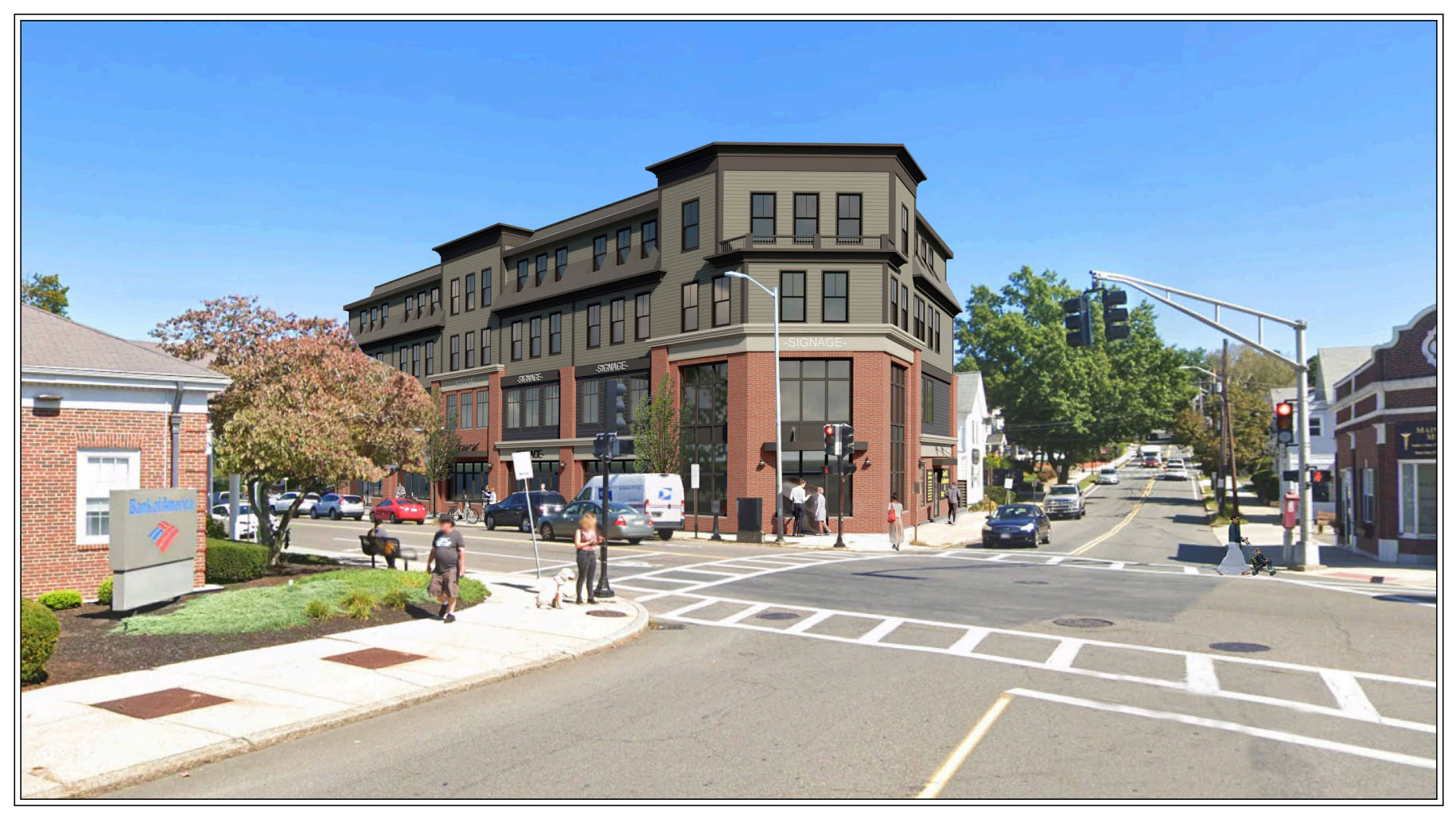
Rendering of plans for a new building at 681-687 & 689-697 Main Street (Caruso’s). These plans will be brought to the Planning Board for Site Plan Review on July 28th.
“Everyone’s always asking about the Caruso’s building (681-687 & 689-697 Main Street),” Grigoraitis said. “It has new ownership now, a local developer with a great track record in Melrose. And the proposal is what people keep telling us they want to see: it’s mixed use with two floors of housing above. They’ve secured state funding to repair the city infrastructure underneath the building. I think people would agree that it will be a vast improvement over the vacant storefront that’s been there for years. But it’s private property - we don’t get to turn it into a park.”
“Saying yes to projects down the pipeline allows us safe harbor status around projects that aren’t a good idea,” Grigoraitis added. “If we say no to everything, we run the risk that we don’t get to say no to anything.”
She also pointed out that, while it might feel as though there are more people in Melrose today, the population still has not returned to the peak it hit in 1970.
And residential developments benefit the city by contributing to the tax base. “Oak Grove Village, which was hugely controversial when it went in, is the single largest development in town,” said Grigoraitis, “and it’s also the largest taxpayer. These buildings pay taxes.” New growth, which is calculated as part of the city’s tax levy every year under Proposition 2½, is largely driven by residential development.
While apartment buildings do use city resources, many buildings may actually pay more in taxes than the value of the city services they use, since families with school-aged children are unlikely to move into a one- or two-bedroom apartment. “There are fixed costs associated with running a city,” Massa pointed out, “They’re using existing infrastructure. We’re not adding more roads. We need the same number of municipal staff, the same number of public safety workers on duty. The costs don’t increase just because the population did.”
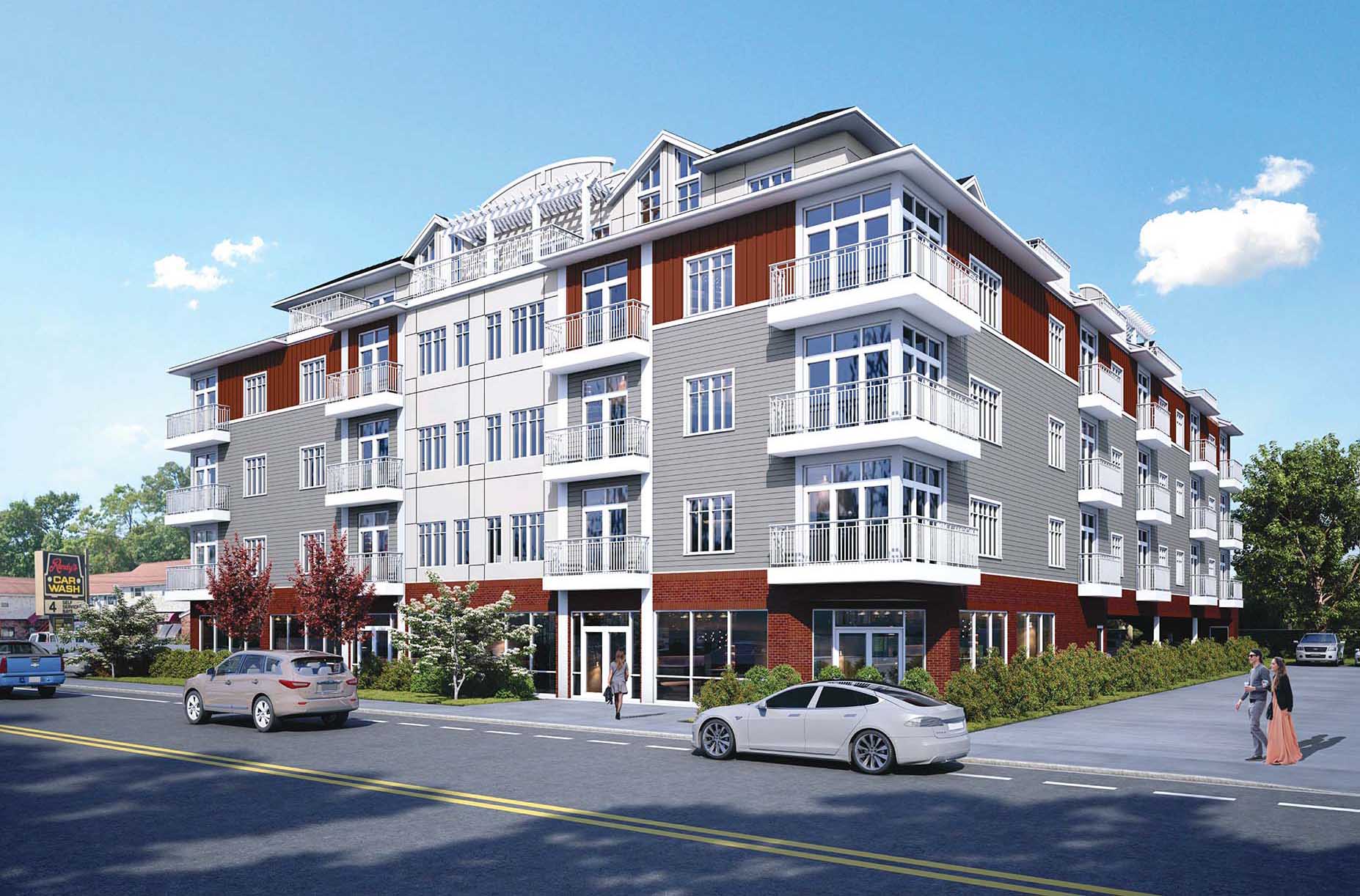
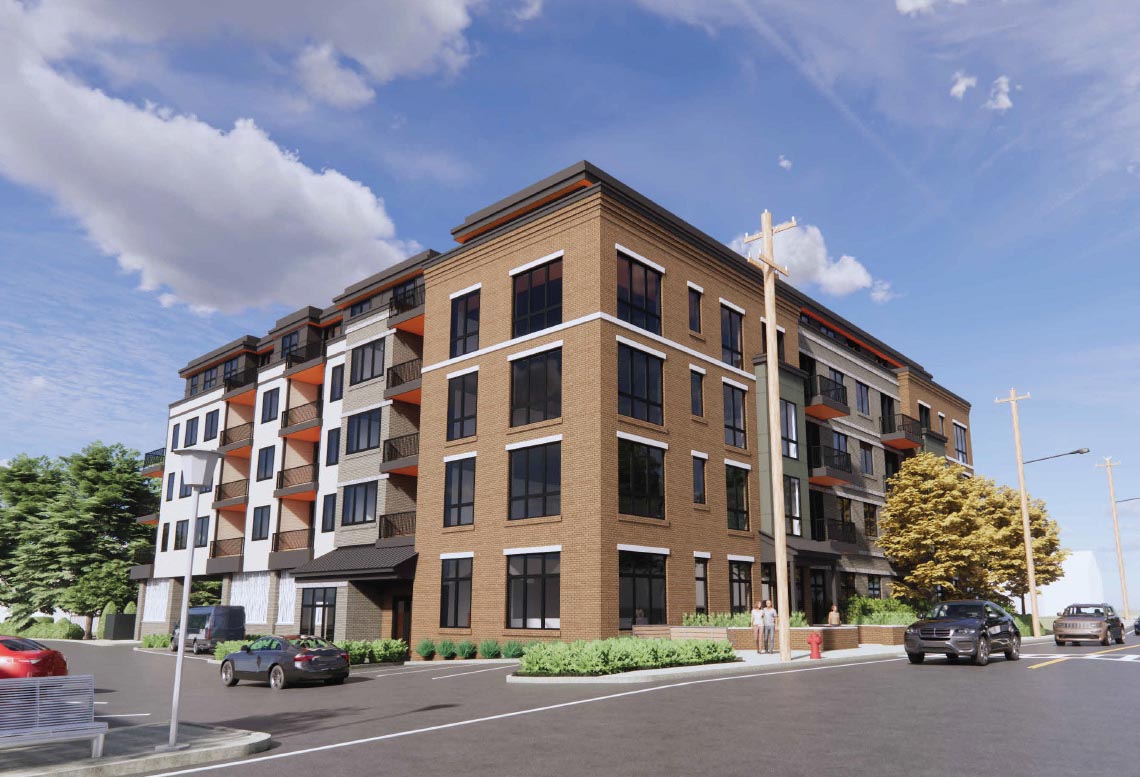
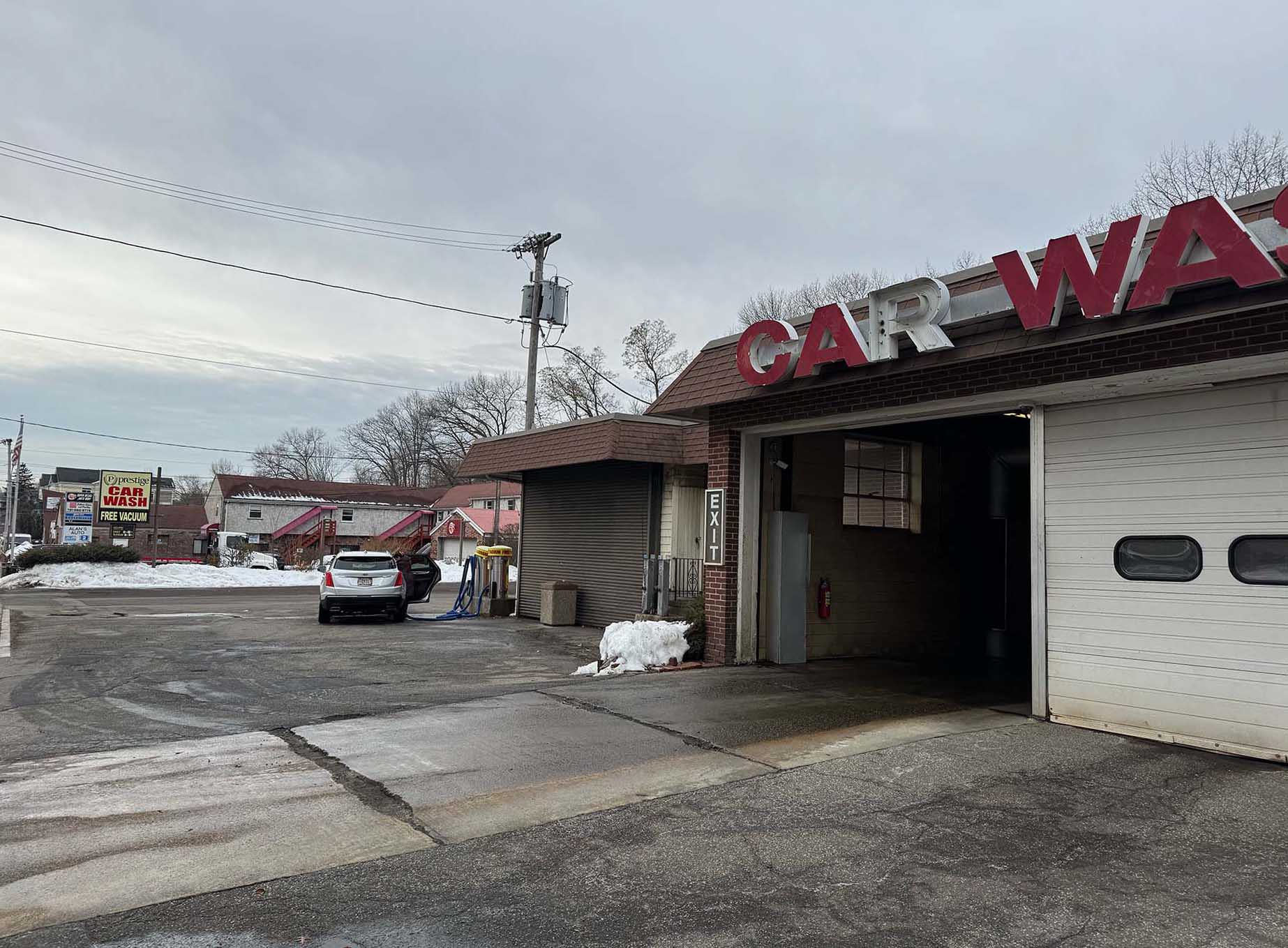
This rendering of plans for 182 Tremont Street (Prestige Car Wash) shows a stepped-back fifth floor.
One point of controversy with some new developments is their height: community members often express concern when five-story buildings are proposed. “There’s an assumption that five-story buildings aren’t allowed in Melrose,” explained Massa, “but they actually are, depending on the zoning district. The fifth floor being stepped back does change the feeling of the building, and we require that.” (The Railroad Corridor Overlay District, for example, allows four-story buildings by right, and allows developers to add a fifth story if they include a public amenity of some kind on the property.)
“Everybody thinks that developers are super greedy, wanting to maximize their profit on every project,” Massa continued, “but it’s true that these projects are really hard to pencil out. When we decided on the height restrictions, we did consider the historic fabric of the city. For example, buildings in downtown used to be higher, and floors were taken off at some point. We looked at the width of the street and the height of buildings and what feels good for being in that space.”
“But we also looked at the return that developers need to get to actually build here,” she went on, “We want quality construction here. We want to make sure the building materials that are used and the site improvements are up to the standard of what people want here, and it’s expensive to do that. Part of the calculation for finances for a project is they have to do all of these other things and not just throw up whatever building is the cheapest to construct.”
Another concern neighbors often have about proposed developments is that they are often designed with fewer parking spaces than there are units in the building. While the city requires a minimum number of spaces for some developments, it does not require each unit to have its own space.
The recently-approved plans for the building at 199-201 Essex Street include 50 units and 20 parking spaces, while the plans that are currently under discussion for 554-556 Franklin Street include 60 units and 45 parking spaces. Both buildings plan to offer unbundled parking, which means that residents would pay extra for a parking space.
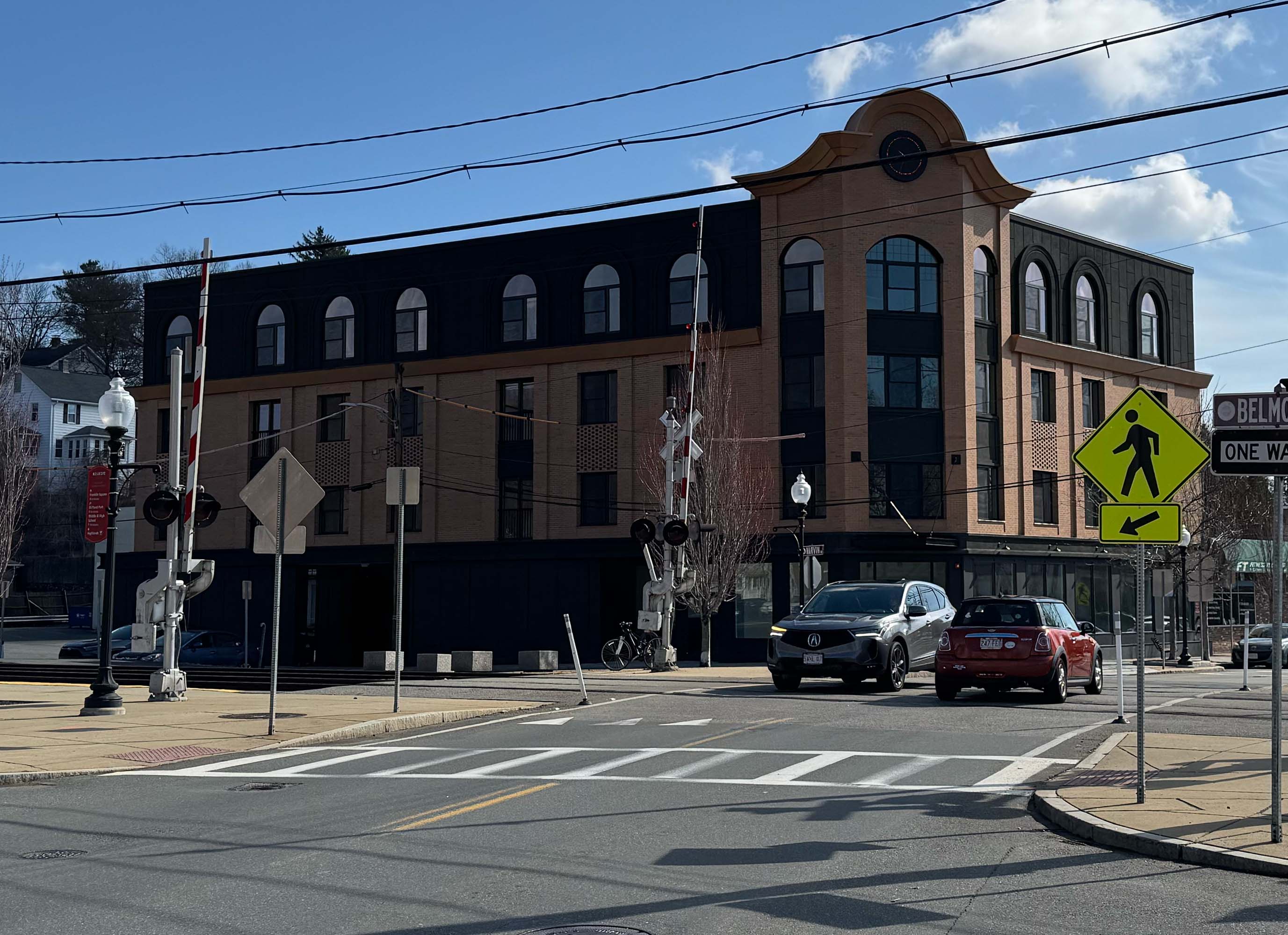
“The Ella” at 453 Franklin Street was recently completed
While Essex Street is within easy walking distance of Shaw’s and the Cedar Park commuter rail station, neighbors were concerned that it might be difficult to live in the Cedar Park neighborhood without owning a car at all. And Whole Foods is a half-mile away from the Melrose Highlands, which is served only by the commuter rail and the infrequent 131 bus.
Since overnight street parking is not allowed in Melrose, residents who live in a building that does not provide them with a parking space can apply for a permit from the city to park overnight in a municipal lot. “We monitor that,” said Massa, “and if we start to fill up the municipal lots, that would be more of an issue, but we’re not there yet.”
Neighbors are concerned about the residents of new buildings parking overnight on residential streets, in violation of the city’s overnight parking ban, and, in the case of Franklin Street, parking in a small municipal lot that already serves as overnight parking for residents of Undercliffe Terrace and other nearby buildings.
“The developer isn’t going to want to build a project they’re not going to be able to find residents to rent to,” was Massa’s response. “None of the units downtown have parking associated with them, and we haven’t had any issues with those property owners saying, ‘we need to figure out where people can park their cars.’ The real issue is, when they’re marketing the units, making sure that residents understand the parking situation before they decide to live there.”
“There are a lot of people who don’t own a car and want to live in Melrose,” she went on, “It’s just hard for people who rely on their car to see that as a possibility. We want more housing but we don’t want more cars on the roads, so we don’t want every project to overpark.”
“We want to be responsive to the concern we hear about not increasing vehicle traffic,” added Grigoraitis, “We don’t allow overnight parking, so if units don’t have parking, tenants aren’t bringing cars with them, and they’re not adding to the traffic.”
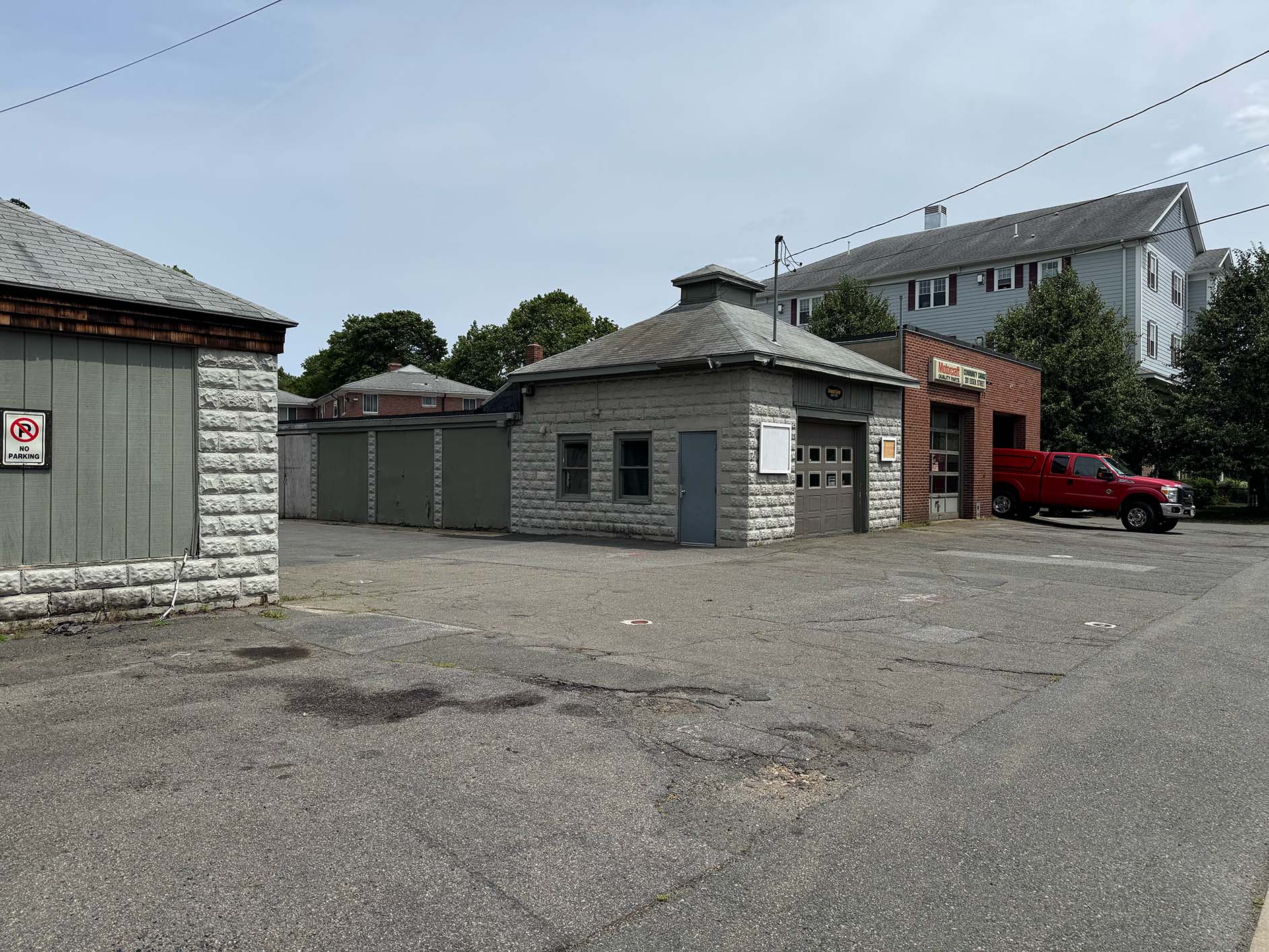
The Community Garage at 199-201 Essex Street (now closed)
Robert Bell of Melrose-based law firm Bell and Izzi, who is the attorney for the 199-201 Essex Street project, remarked, “In general, we’re marketing this building to a demographic that does not place high demand on automotive use. The age demographic skews young. They don’t want cars. They don’t need cars. They use rideshare, they walk, they bike, they use public transportation. That’s the profile. It’s already proving itself in other buildings that have been approved by the city.”
“I think this design is really compatible with what the city has been envisioning,” Bell went on, “for the rail corridor to turn over from obsolete commercial units, properties that are not bringing any substantial tax return to the city, into higher yielding properties, and in so doing also address our moral and legal obligation to provide housing.”
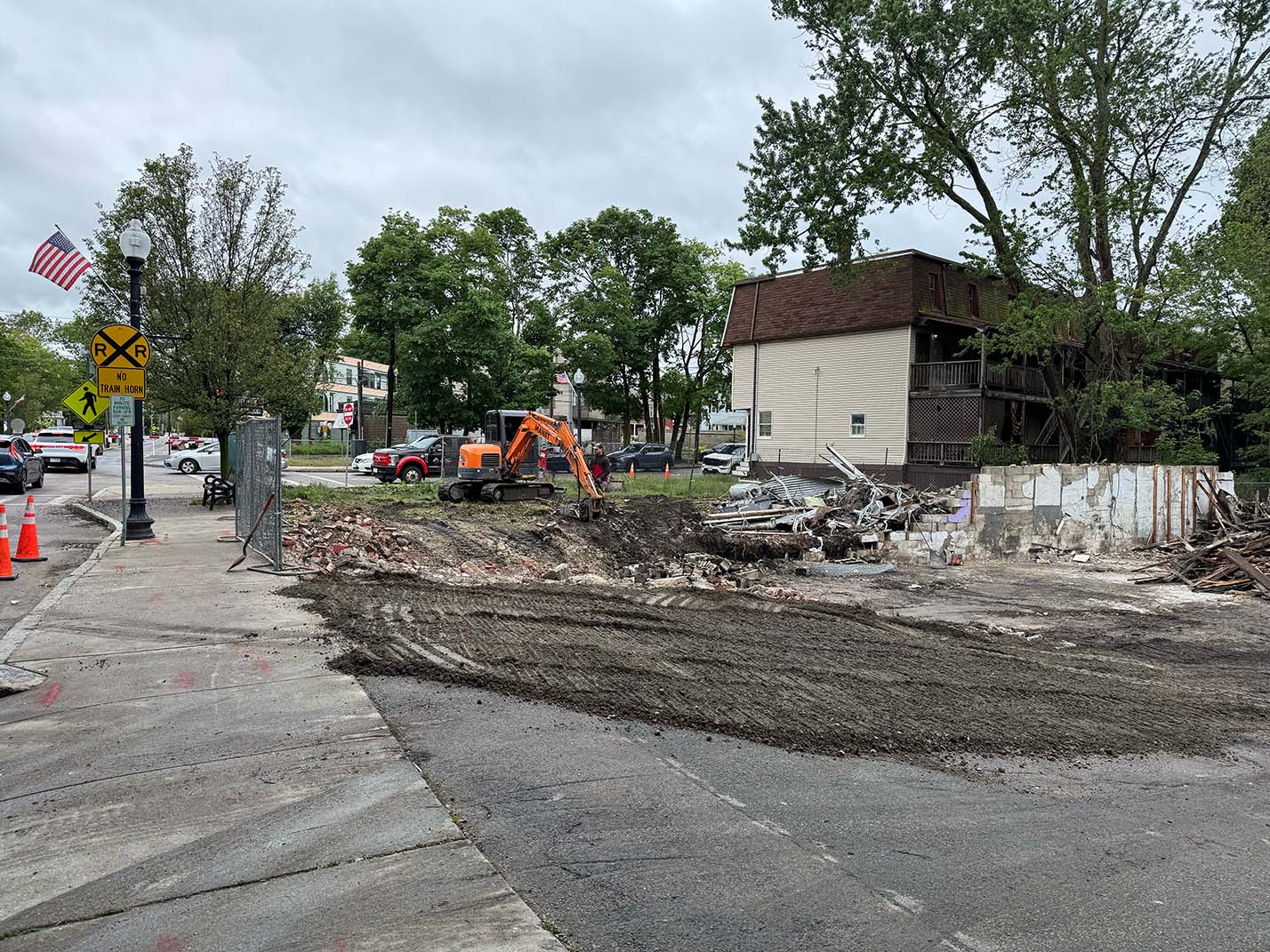
199-201 Essex Street has been the site of the Community Garage, which owner Ozzie Wheeler sold after he retired and his children declined to take over the business. “I take pride in redeveloping properties that are at the end of their life cycle,” said developer Mark (Woody) Carroll, who is a Melrose resident, “and I think the improvement will be a major asset in that location.”
Project consultant John Connery added, “I’m convinced that the policy of putting housing along the railroad tracks is the right policy. I don’t want to be involved in blowing up neighborhoods with 40Bs when we have plenty of room to put it along the tracks and make a better city.”
While discussion of 199-201 Essex Street remained largely polite, with a few neighbors even voicing their support for redeveloping the site, opposition to the 554-556 Franklin Street project was pronounced at a tense ZBA meeting on Wednesday night.
ZBA Chair Bryan Thorp reminded the public, “when it’s a 40B project, the city has very specific requirements from the state in order to rule against the project. We have very clear guidelines that we have to follow. I don’t want to minimize any of what the public is saying, but the specifics of the 40B process and what state requires us to do make it difficult to stop projects and effect a lot of change. We’ve worked out a number of issues on other projects in the past with the applicants, but we can’t stop projects like this altogether.”
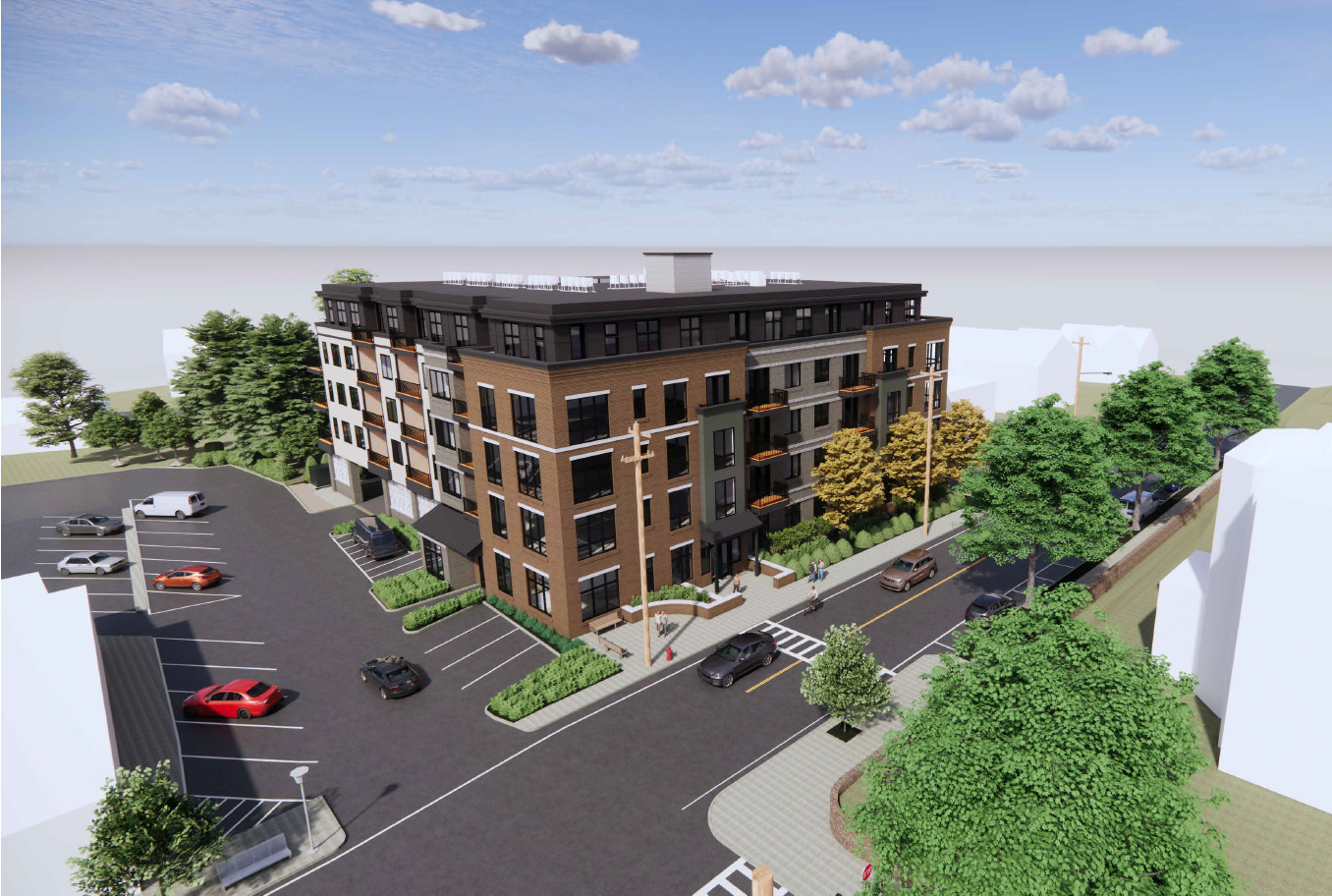
Rendering of plans for 554-556 Franklin Street
But residents at the meeting were still visibly upset about the plans. One neighbor called the project a “colossal overbuild,” while others expressed concern about the total number of units being added to the neighborhood over a short period of time. (453 Franklin Street “The Ella,” is already complete and largely occupied, but other projects at 14 Chipman Ave, 521-529 Franklin Street, and 28 Greenwood Street have yet to break ground - and neighbors are also concerned about added traffic from 259 units being built at Weiss Farm in Stoneham.) Residents worried about increased traffic, especially at the commuter rail tracks and at Greenwood Street, as well as about pedestrian safety, which is already a concern in the area.
“The Highlands is a unique community,” said one resident, “and there’s ample land to thoughtfully design the space. By rushing to approve a series of generic five-story buildings, we’re setting up challenges for future generations. If this is built as-is, it will permanently damage the neighborhood for the sake of for-profit developers.”
Project attorney Jesse Schomer responded to negative comments from neighbors, “The governor has said we need over 250,000 new housing units in the state before 2035. And the way you do that without cutting down forests in Central Massachusetts and putting new cars on the road is by building places like this, within a stone’s throw of transit. There are always going to be opinions that a neighborhood shouldn’t change, that it should be fixed in time, but unfortunately, we’re in a housing crisis. The phrase you hear when you do this long enough is, ‘I’m in support of affordable housing, but please build it somewhere else.’”
“We are members of the community,” said ZBA member Chris Coughlin, “and we do genuinely care about your feedback. We live here, too. But we have to weigh the concerns and needs of the community with stuff that, in an ideal world, we wouldn’t want to see. Our hands are tied to a degree.”
The city's Office of Planning and Community Development created a guide for the public about the development review process. Residents are also welcome to call or email the Planning Department with any questions about specific projects or about development review in general.