Back to School in Melrose Comes With Staffing Changes and Budget Adjustments
By Ellen Putnam
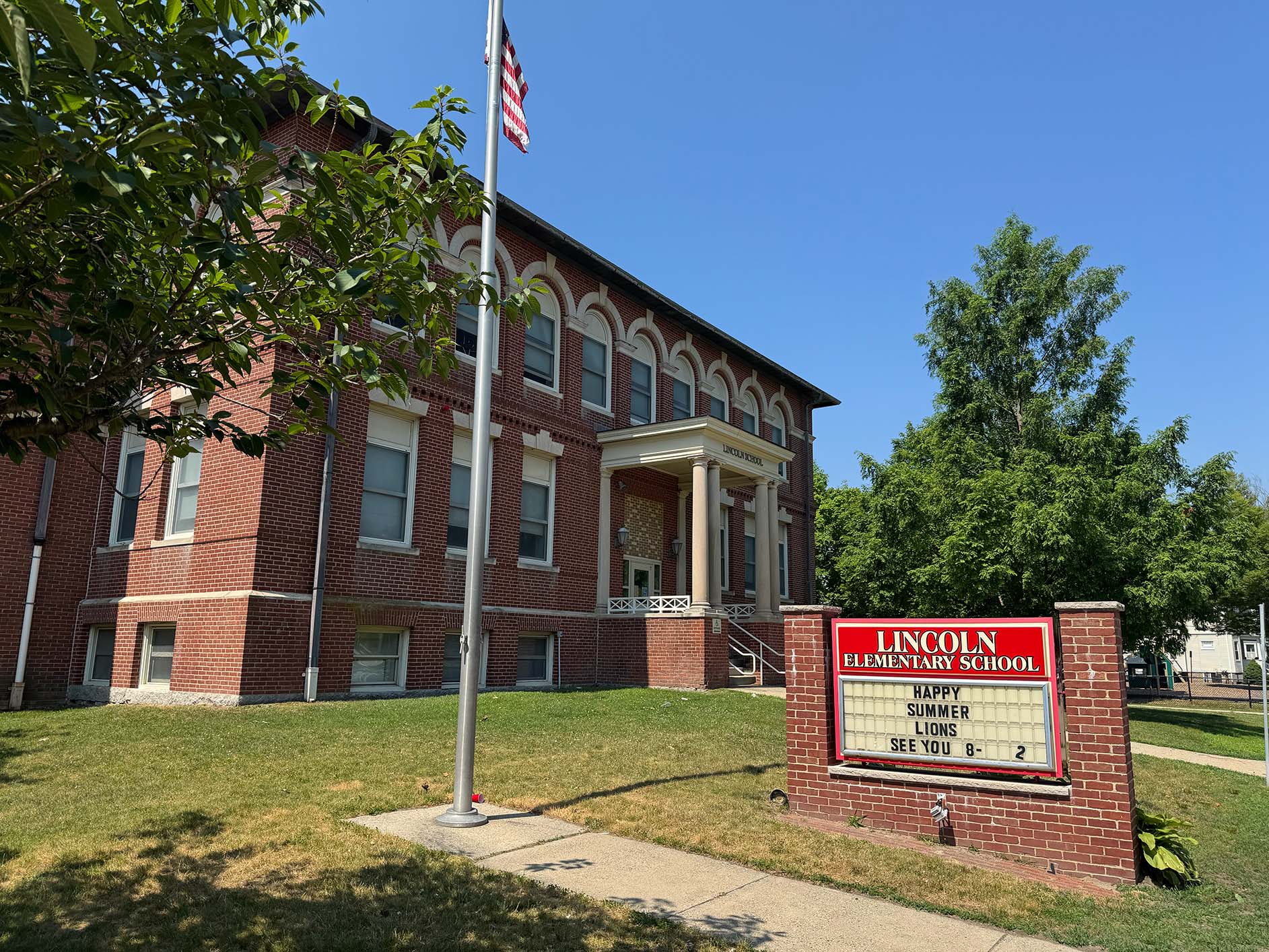
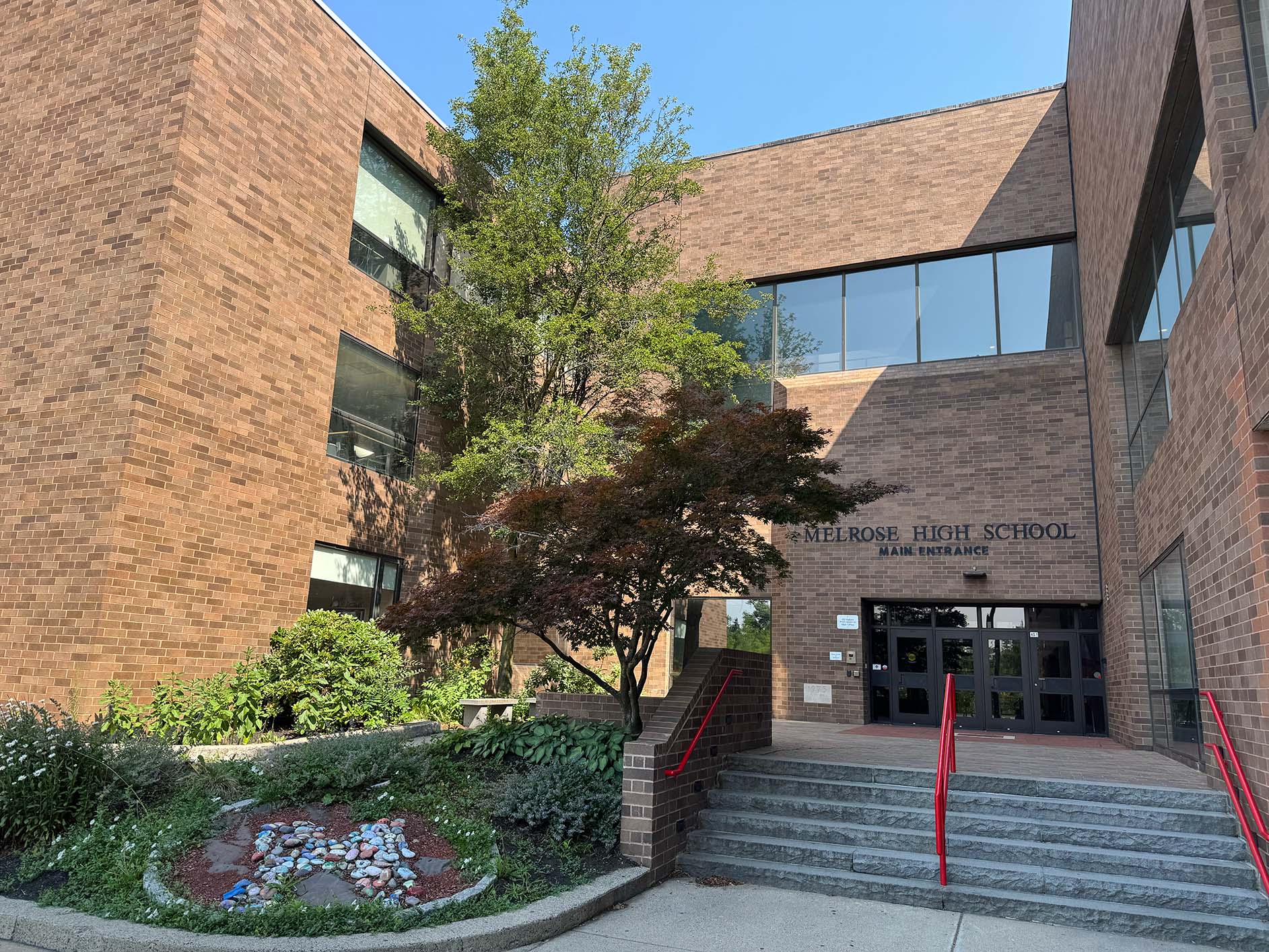
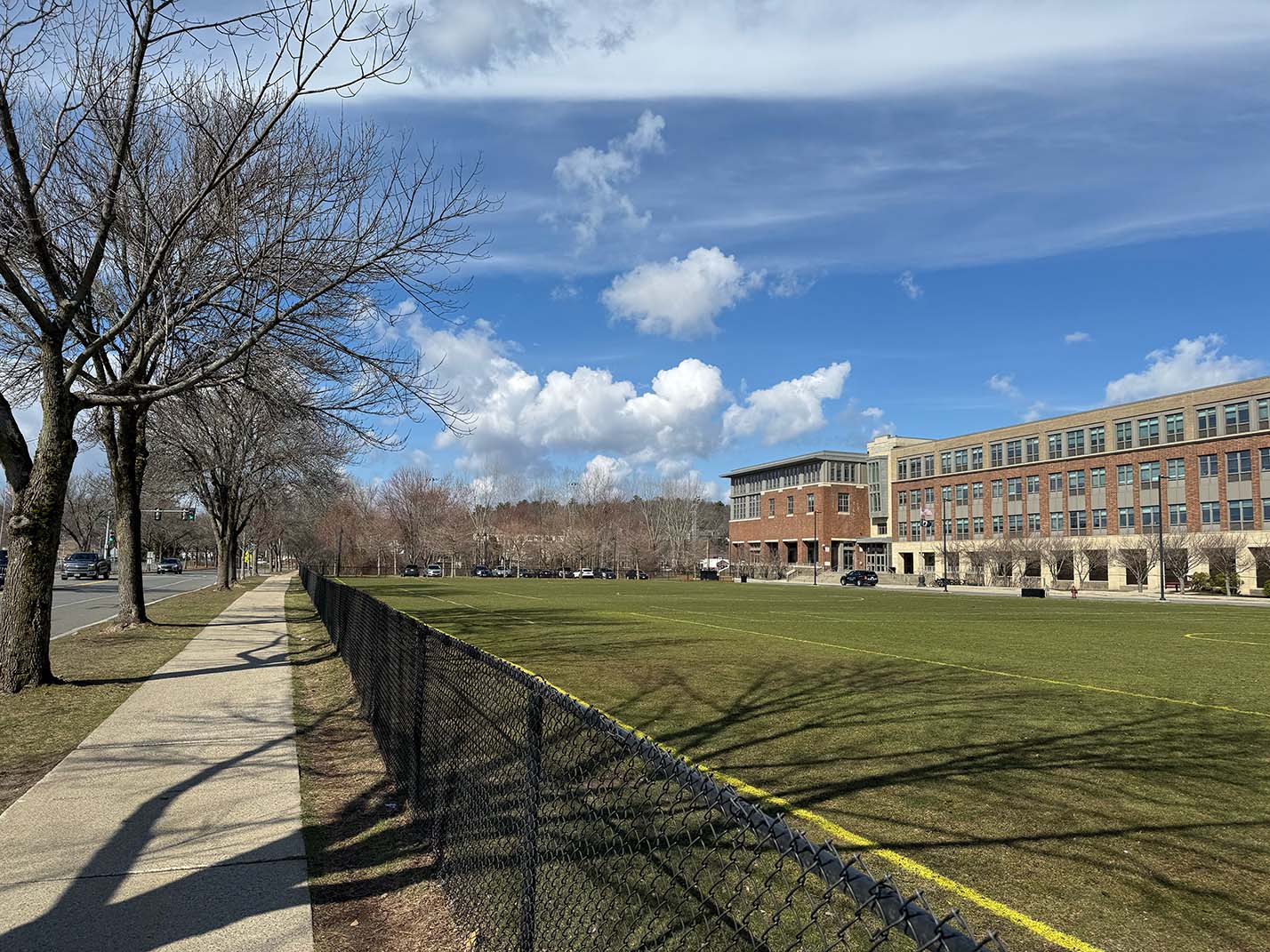
Melrose students will return to school next Wednesday, August 27th, and school administrators are preparing for their return with a few final staffing changes and budget adjustments.
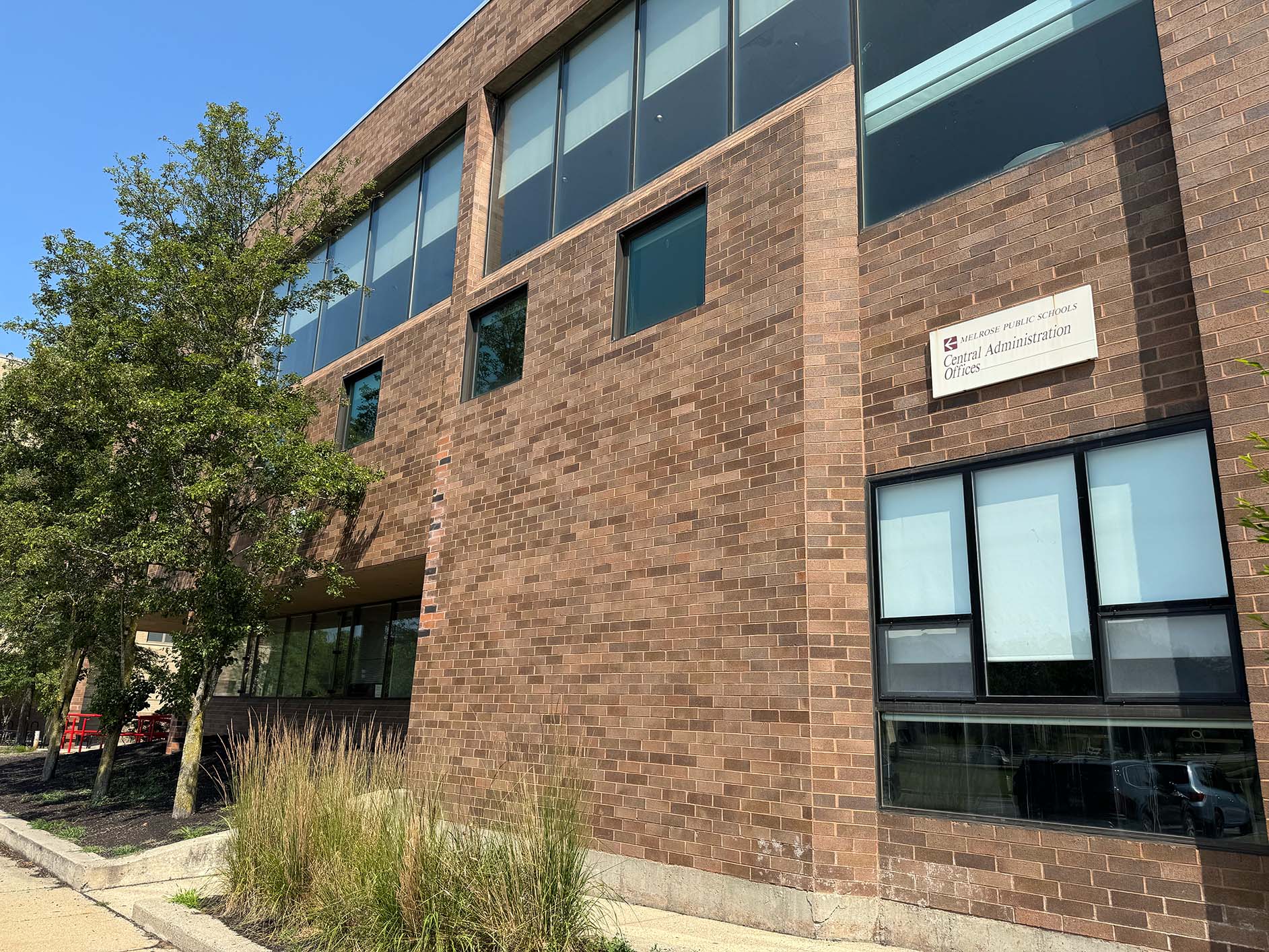
The reorganization of the Melrose Public Schools’ Central Office, which began during the budget process this spring and continued with the departure of Adam Deleidi from the superintendent position in June, appears to have concluded with the hiring of the final member of the executive team. And the now-combined leadership team of Melrose Veterans Memorial Middle School (MVMMS) and Melrose High School (MHS) will be complete when a final member of that team is hired soon.
These staffing changes are due in large part to the $4 million in cuts that were made in the Melrose Public Schools (MPS) budget for the 2025-26 school year (which corresponds with Fiscal Year 2026, or FY26). These cuts were made to fill a $6.6 million budget deficit in the city budget that was caused by costs rising faster than revenue in a number of budget areas, many of which are legal or contractual mandates.
These cuts included the elimination of four administrator positions and 31 teacher positions across the district. Some of the lost administrator positions, which included the Assistant Superintendent for Teaching and Learning, resulted in the effective closure of the Teaching and Learning office. This office, which had a staff of directors, coaches, and specialists as recently as the 2023-24 school year, now has only an Executive Director of Academics and Accountability and a single Director of Academics, 6-12.
When Cari Berman, who had been the Assistant Superintendent for Pupil and Personnel Services, moved into the role of Interim Superintendent, she led a reorganization of the district’s Central Office, elevating Business Manager Ken Kelley to the role of Interim Deputy Superintendent. The district then hired Linda Chase and Marc Kerble to share the role of Interim Special Education Director and take on many of the responsibilities Berman had in her previous Assistant Superintendent role.
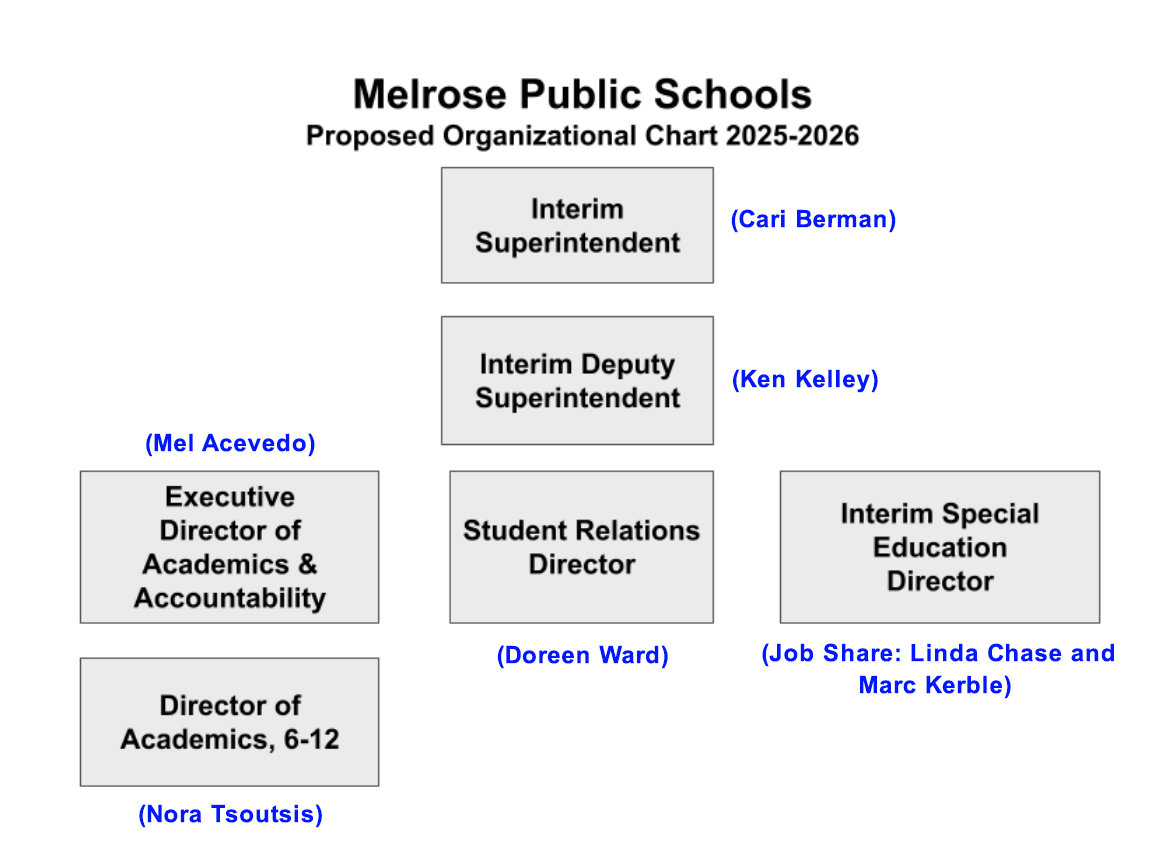
MPS Central Office leadership after reorganization in June
From Melrose Public Schools (names added by The Melrose Messenger)
With the departure this spring of Nyra Hall, the previous METCO Director, the district reorganized her position (which any district that accepts students from Boston through the METCO program must have in some form) into a new Student Relations Director position, which will be responsible for the METCO program along with other responsibilities, including handling civil rights issues within the district. Doreen Ward, who had served as Melrose’s METCO Director for over two decades before she left for another district in 2019, will return to this role to round out Central Office leadership.
“I was really excited to see that Doreen Ward was the person who you selected for the student relations position,” School Committee member Jennifer Razi-Thomas said at last night’s School Committee meeting. “She did a tremendous job for us in the past and I think she’ll hit the ground running with trust with the communities that she’s going to be working closely with.”
Other changes come as a result of additional state funding for Melrose, which was approved by Governor Maura Healey in July when she signed the state budget for FY26.
This 2.5% increase in state aid for Melrose above the amount that had been expected earlier in the state budget process includes an additional $298,875 in Chapter 70 funding for the Melrose Public Schools. The additional funds are relatively small in comparison to the $21 million Melrose will receive in state aid this year, and to the city’s total budget of $107.5 million. State aid makes up almost 28% of the Melrose Public Schools’ $48 million budget, with the additional funds providing a 0.62% increase in the school budget.
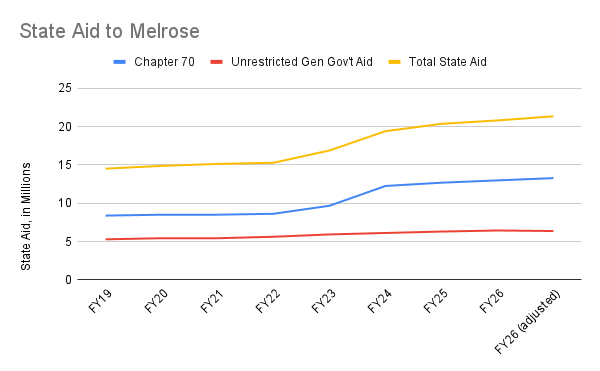
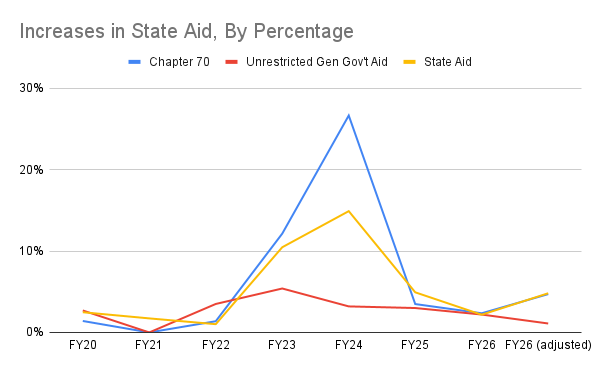
State Aid to Melrose since FY19, by amount (above) and by percentage change (below)
“It’s not unusual for Chapter 70 to come in a little higher than budgeted,” explained City Communications Manager Tom Dalton, “and typically it doesn’t change a lot in the immediate sense. We still budget conservatively on everything, and that bit of extra money matters more as the school year goes on.”
“It’s not necessarily enough money to start making big changes,” he added, “but it can reinforce areas of the budget where we need it.”
“This increase in Chapter 70 funds is a welcome increase, but we are still drastically below where we need to be for next year,” School Committee member Jennifer McAndrew said at July’s School Committee meeting. “These funds won’t be anywhere near what we need to restore the teaching positions that we cut.”
School Committee member Margaret Driscoll cautioned that the district should be conservative in using the additional funds. “I’m extremely concerned about federal funding cuts and the resulting state funding cuts,” she said, “so I hope that one-time use of some of those funds can provide a cushion for a later point in time when the rain may be coming harder than a sprinkle or even a gentle rain - when it really starts pouring.”
One area that both school officials and School Committee members have expressed concern about is professional development for teachers, which is administered by the now-diminished Office of Teaching and Learning. “I’m wondering if we’ve really slaughtered Teaching and Learning in terms of that budget line,” reflected Razi-Thomas, “and maybe we need some money there for curriculum or professional development.”
Kelley did note that the $125,000 earmark funds that Melrose Public Schools received for improvements and supplies “would be very supportive of materials, so prioritizing the other funds for what students need is probably the best use of those funds.”
The School Committee ultimately voted to divide the additional funds evenly between the Elementary and High School budget lines, and the superintendent will decide how to spend them within those categories.
“The use of any additional funds is always based on student need prioritization,” Kelley added. “We’re already having some discussions about this additional revenue and looking to build in Tier 1 supports that reach all students.”
While the additional Chapter 70 funds will largely be used to support and reinforce the current budget, they will be used to add one position: a Dean of Students at the secondary campus, where budget cuts hit especially hard this year.
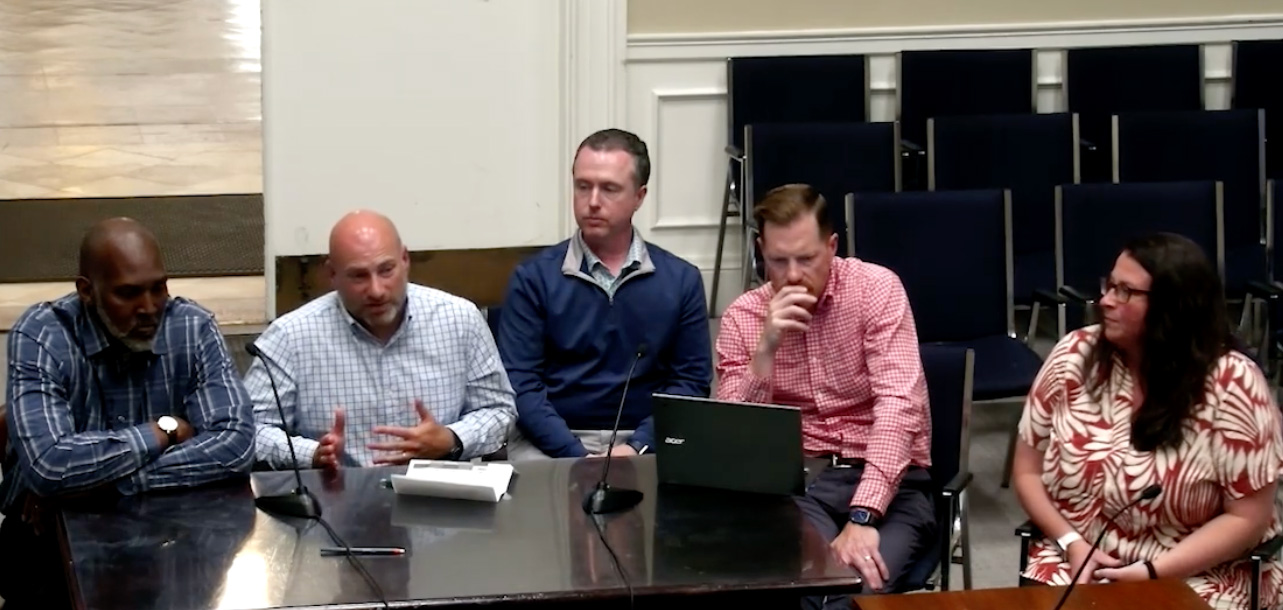
Speaking at the August School Committee Meeting, left to right: MHS Assistant Principal Christopher Beaver, Secondary Principal Jason Merrill, MVMMS Assistant Principal Steve Black, Deputy Principal Bryan Corrigan, and MVMMS Assistant Principal Michelle Sewyck
Screenshot from MMTV
In addition to the loss of 15 teacher positions at MVMMS and eight at MHS - which will mean not only larger class sizes but also fewer adults available to supervise and enforce appropriate student behavior - the middle school principal position was eliminated in the FY26 budget. This makes Jason Merrill, who has been the district's high school principal for over a decade, the leader of both the middle and high schools. Bryan Corrigan, who has been one of the two assistant principals at MHS, will serve as Deputy Principal of both schools, leaving Christopher Beaver in his position as assistant principal at MHS, and Michelle Sewyck and Steve Black as assistant principals at MVMMS.
“Mr. Merrill and Mr. Corrigan have been working really hard to ensure that our classrooms are staffed appropriately at both the middle school and the high school,” said Berman. “We continue to be focused on legal compliance. Even with these additional funds, we’re figuring out one position, maybe two, and where we put those. There are needs, as we know, across the district, but an identified need has really come to the top of where we think this could best land, and that is this Dean of Students position at the high school.”
“We’re losing some administrative staff at the high school,” Merrill added, “We’ve taken a little more of a hit than the middle school.” This is because the middle school will maintain a total of 3 administrator positions - two full-time assistant principals and half of each of Merrill and Corrigan’s positions - while the high school will be losing a position, with Merrill and Corrigan only working there part-time, for a total of two administrator positions.
“In order for us to make a real positive impact and accomplish some of the goals we want to accomplish at the middle school,” he went on, “Mr. Corrigan and I are going to need to be over at the middle school in classrooms and hallways together, so there will be times we’re going to need a little bit more support at the high school.”
“We envision this position as a support to the secondary schools in many ways,” Merrill continued. “They could be at the middle school at some points in time, and we envision them probably having some more specific role at the high school, but that’s in order to give Mr. Corrigan and I more time and more visibility at the middle school.”
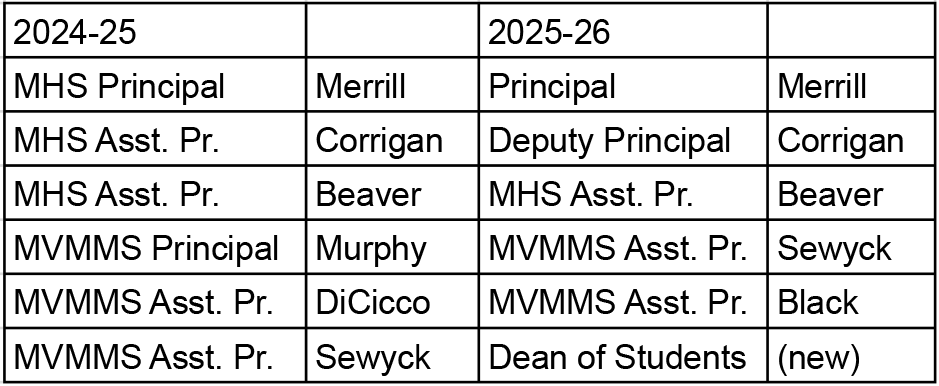
The leadership team at MVMMS and MHS, comparing last year with this year
While the Dean of Students position would provide administrative support, they would not be an administrator, and compensation would be only slightly higher than that of most teachers. The job posting gives a salary range of $64,000 to $101,000 for the position, based on the candidate’s education and experience, which is lower than the $100,000 to $125,000 salary range for the current secondary assistant principals.
“This position would be working under one of the Assistant Principals,” said Merrill, “and they would handle some of the typical discipline-type interactions with students. They would be enforcing positive behavior and the Code of Conduct. They would be constantly in the hallway being visible for students, visible in classrooms, helping with lunch duty across the campus - which will be a bear at times with fewer adults and everyone eating at the same time.”
“This really helps piece the puzzle together for us,” Merrill concluded, “and will hopefully complete our team to support our students on campus.”
McAndrew emphasized that, while members of the public might be surprised to hear that the school district is hiring new staff, some of the new hiring is actually a result of the cuts that the district made this spring.
“In this pretty severe budget year that we’re in, we cut a lot of educator positions,” she said, “but you’re also trying to fill different holes because of the cuts.”
“We’ve had people move on or decide to retire last-minute or even move out of state, so we have to hire to fill those positions” added Berman, but aside from the Dean of Students position, “none of these positions are new. We had the smallest new teacher orientation that we’ve had in many years - I think we had 17. It’s usually much much larger than that.”
“We have lost staff members, specifically over the past two weeks,” added Corrigan. “We have lost staff members who barely kept their job this year because of the budget and are going somewhere more stable. I’m specifically thinking of a few great teachers who just can’t afford to ride it out with the state of our budget and the state of our school system. When people leave, they could potentially be teaching 150 or even 300 kids - we can’t just not fill the position, or there would be nowhere for the kids to go. But we’re not in the best shape to be attracting and retaining teachers right now, given our situation.”
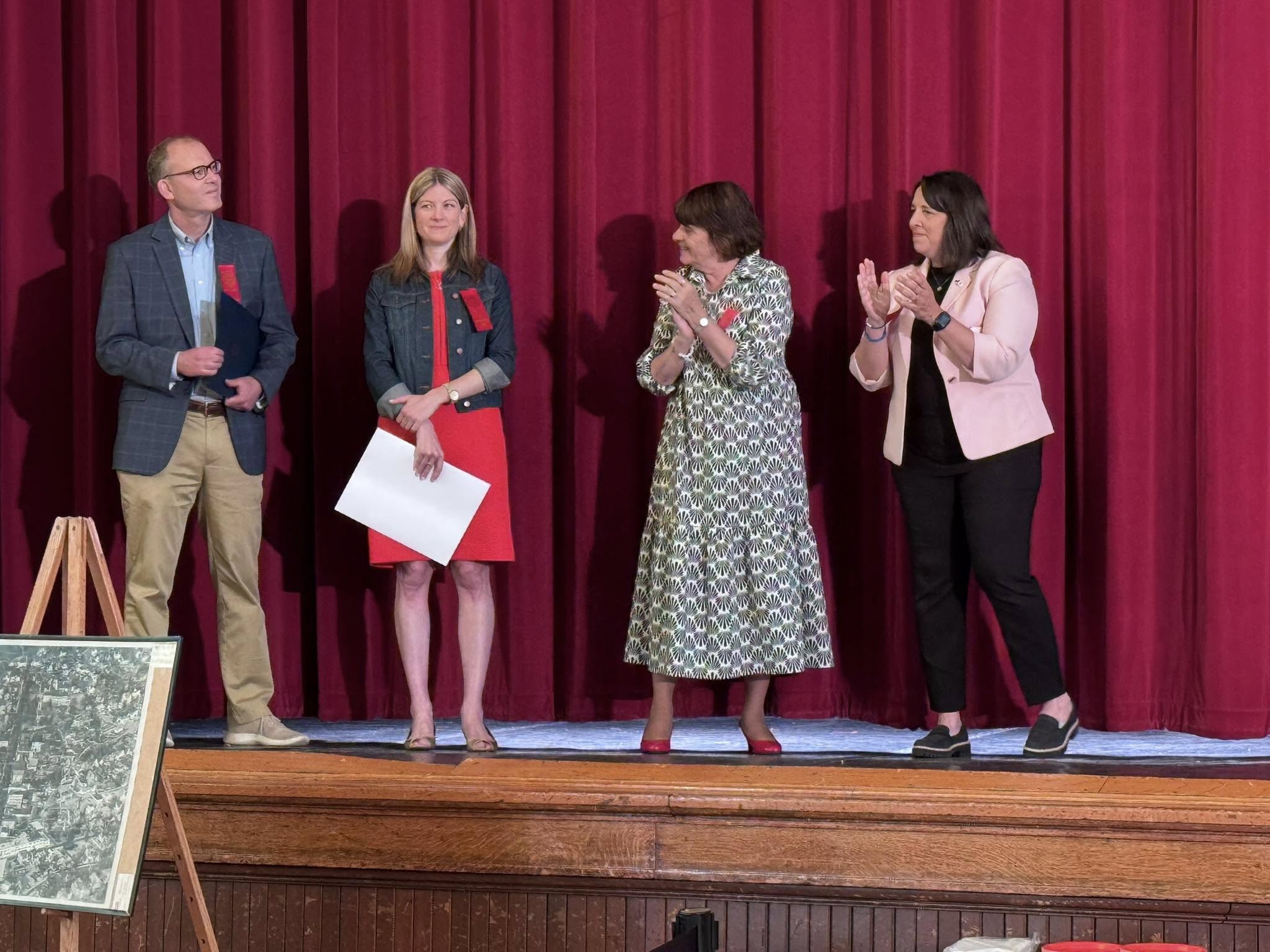
Senator Jason Lewis, left, and Representative Kate Lipper-Garabedian, second from left, at Melrose's 175th birthday celebration this spring
Photo Credit: Nancy Clover
During the budget process this spring, School Committee members and city officials had expressed the hope that Melrose would see an increase in Chapter 70 funding that might allow them to add back one or more of the positions that were eliminated. However, the final number for state aid was not set until Healey signed the state budget last month.
All municipalities in Massachusetts receive both general government aid and Chapter 70 funding for their schools according to a statewide formula. Melrose’s state delegation - State Representative Kate Lipper-Garabedian and State Senator Jason Lewis - worked with their colleagues at the state level to set the amount of aid Melrose will receive this year, and secured an additional $550,000 in earmarks for the city and the schools (some of which are currently on hold at the state level due to the uncertainty of federal funding for next year).
“I’m proud that this budget, passed with bipartisan support, will deliver critical resources for our public schools and communities, and will make our state more affordable for working families with significant investments in childcare, housing, and healthcare,” Lewis said in a statement last month. “I’m especially pleased that Representative Lipper-Garabedian and I were able to secure funding for improvements to Melrose Public Schools and other local Melrose priorities.”
“The FY26 Budget is a powerful statement of our values as a Commonwealth at a time of unparalleled and astonishing federal executive branch actions that undermine our civil rights, civil liberties, and safety,” said Lipper-Garabedian. “In Massachusetts, we recognize the value of supporting public education, investing in a more reliable public transportation system, protecting the right to safe health care, and aiding local non-profits that do critical work in our communities. I’m additionally glad to secure local earmarks with Senator Lewis that prioritize these values and support Melrose residents.”
“With the budget challenge Melrose faces, it was important to me this budget cycle to secure as much state aid to the city as possible,” Lipper-Garabedian added. “These additional state funds provide a boost to Melrose’s budget overall, including the school budget specifically.”
While the increase in funds for the schools is a welcome change, Mayor Jen Grigoraitis noted that state aid to Melrose did not increase unilaterally: Unrestricted General Government Aid to Melrose actually fell by $69,463 relative to initial estimates. Grigoraitis had pledged at the start of the budget process that any increase in Chapter 70 aid would go to the schools, with the city budget receiving a corresponding decrease, although Dalton noted that there should be enough give in the city budget to absorb the decrease without reallocating funds.
“It’s important to remember that the state gives and they take away,” said Grigoraitis, “and the fundamental math doesn’t really change all that much.”