Candidate for City Council At Large: Jason Chen
By Ellen Putnam
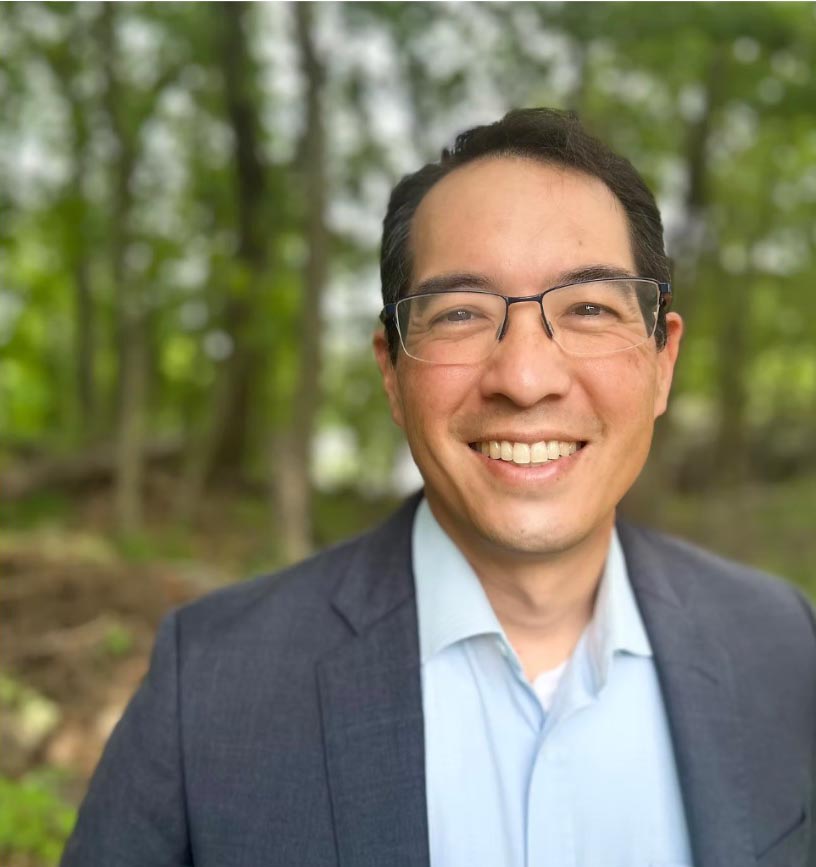
Photo From Jason Chen
Jason Chen is running for City Council At Large because, he said, “I want to help keep Melrose on course for the short term and the long term.”
In particular, Chen intends to focus on ensuring that the $130 million Public Safety Buildings Project stays on budget and on time; pedestrian and traffic safety issues related to new housing developments; and, whether an override passes or not, “making sure we properly prioritize our spending and helping people understand how the money is being spent.”
“Our city is facing some difficult challenges right now,” he went on, “and my experience in leadership and operations, and my connections to the city staff and the community, will prepare me to help tackle these issues.”
Chen began his career in the Navy as a submarine officer. He now works for Corning Life Sciences producing flasks, vials, and other equipment used in scientific labs and biopharma production. In his current role at Corning, he manages a team that develops new products from the idea phase all the way through production.
“My role,” he explained, “is to rally a bunch of stakeholders together, commit resources to a plan that will move the needle and solve the problem, and deliver a product solution.”
“I believe this will translate well to the City Council,” he went on, “because I’m good at working with different functions and stakeholders. Our projects face a variety of challenges, which our program managers must handle. Sometimes, the problem is a technical or engineering one. Other times, it’s organizational, or trying to figure out the right way to partner with a team, customer, or supplier. Other times, we need to improve our process or systems. I enjoy being thrown into the ambiguity of a problem and figuring out how to get a team to come up with the best answer.”
Chen’s experience in local government includes serving on the Public Safety Facilities Advisory Committee and on the search committee that hired Police Chief Kevin Faller. “Through my work on these committees,” Chen said, “I’ve gotten to know some of the city staff and built good, collaborative, and trusting relationships. I’m able to challenge and question them and they know that it comes from good intentions and not an attempt to ambush or undermine them or to make myself look smart. I believe those relationships will help my work as a city councilor.”
“My leadership is ultimately rooted in humility, reliability, and building trust with others,” Chen continued. “I hold myself to the highest personal integrity. I’m there to serve, and it’s not about me or my role or my title. It’s about being a steward of public money and resources. I show up on time, and usually send my part of the project homework ahead of time so others have time to review and digest. I respect experts and different opinions; and work together to come to the best decision to maximize our resources. And then, once we’ve made a decision, I stand by it and explain it openly.”
“As a veteran,” he went on, “I feel accountability and responsibility in being entrusted with a public office and leading and representing others. Public service requires humility, fostering collaboration, and balancing values with pragmatism. I’ve learned that how we make a decision is often as important as the decision itself. Stakeholders need to feel included and respected, and being right is not enough. I can’t say I always get this right, but it’s something I’m working on.”
“Even in these challenging times,” Chen continued, “I’m still optimistic about what local government can do. We can’t change the direction of politics at the national level as easily, but I feel that I can step up locally. And local government has a real face - I’m the same person you see at Rising Eagle, on the soccer sidelines, or at the YMCA.”
“I aim to stay balanced, seek out the truth, and focus on what I can and can’t control,” he added. “I’ve been through enough life challenges to not have a huge ego. City councilor may be a more visible role, but I do it out of a sense of service and civic duty, not because of the prestige. This isn’t about winning an election - it’s about the opportunity to serve my community, and I will continue to serve, whether or not I have a seat on the Council.”
“We have a lot of really engaged citizens,” Chen said, “and that’s a huge strength. There’s a whole mix of people who want to move here. We have really committed city staff - our first responders, our civil servants at City Hall, and our teachers are all generally working for below average pay, but they stay here anyways. We have vibrant neighborhoods and a real sense of community, which is unusual among cities of our size. I love that my kids can bike across town and roam the city on their own.”
“On the other hand,” he went on, “we have real financial constraints. Our funding is limited by Prop 2½, and we can’t fund all of our priorities at once - we have to make hard choices. There’s a major need for capital repairs - we’ve kicked that can down the road for decades. There are major concerns with traffic and pedestrian safety with all of the new developments that are going up, and they will demand more from our public services.”

Photo From Jason Chen
“As a city councilor, I would bring my experience solving large, complex system problems with limited resources to the table,” Chen said. “I’ve solved a number of these in the Navy, in the companies I’ve worked for, and on the committees I’ve served on. We need to make thoughtful tradeoffs and explain how we’re using people’s taxes efficiently.”
“And we should learn from other cities,” he added. “There may be innovative ways to do more with less, that challenge the existing way of doing things in a collaborative and constructive way. When I speak to people around town, a lot of them have great ideas for how we could do things differently. For example, we could train AI agents to help citizens interact with and get information from the city - and that might free up staff to do higher-level tasks.”
“The role of a councilor at large often involves going deep in a few areas,” Chen said. “For me, those areas would be capital projects and spending, as well as development and traffic control, and how those all play into our long-term planning. I would scrtuinize our spending, speak with experts, make sure our capital projects stay on budget, and think about how we can grow our tax base responsibly and attract more businesses to Melrose.”
Chen fully supports a “Yes” vote on all three of the three override questions that will be on the ballot although, he said, “overrides are not easy - no one ever wants to raise their taxes. But it’s necessary in order to maintain the level of services that residents have come to expect - and that they deserve. We can’t sustain vital city and school services under our current revenue constraints.”
“Some residents are on fixed incomes and find increased taxes to be a real burden,” Chen added, “and there a number of programs that can help, including the workoff program. We need to make sure people know these programs are available.”
And, he went on, “the override should be paired with a clear plan for accountability. Residents should know how their dollars are being spent to benefit the community.”
Specifically, Chen wants to make the city budget, which can be very dense, easier for residents to understand. He has begun making videos showing where residents can find information about the budget, and he plans to do some deeper dives into specific aspects of the budget. “There needs to be a layer of communication that translates the information that the city is putting out in a digestible way, short of people having to watch all of the City Council meetings or dig through PDFs,” he said.
“People should understand how much control the city actually has,” he added, “what is mandated by law, what services we’re required to have - and that drives a certain amount of our spending.”
“When it comes to our union contracts,” Chen went on, “some people will say, ‘maybe we need to negotiate harder against the unions,’ but we need to look at: what is the going rate for unions in the area? Are we paying competitive salaries to attract the best people? It’s a short- vs. long-term tradeoff. You can save money by paying people less, but what do we give up in the medium and long term by doing that? Experience and expertise can be harder to quantify, but they can get lost in a discussion of how many people you have working and how much you’re paying them.”
Chen also wants to focus more on long-term capital planning. “We need to set our priorities and expectations about what needs fixing and when,” he said. “We’re at the end of the bandaid-repair road for a number of our city buildings - we should have been sequentially updating and maintaining buildings along the way. With home repairs, you know that you need to keep on top of them, or else you’ll end up having to make more expensive repairs down the road - and it’s the same with our city buildings.”
With his role on the Public Safety Facilities Advisory Committee, Chen will also focus on keeping the public safety buildings project on track. “Both our police chief and our fire chief have been forward-thinking in reducing the footprint of the buildings and adapting to our budget realities,” Chen reflected. “And I credit Fire Chief White for his decision to move the renovation of the Fire Headquarters on Main Street to the last phase of the project - that could become a money pit, given how old the building is.”
And Chen aims to help alleviate some of the community’s concerns around development. “I live in Ward 1,” he said, “on a cutthrough street - many people zoom down our street every day to avoid the busy intersections by the Highlands commuter rail station. And the traffic is getting worse with all of the new development in the area, especially in the mornings when the trains come by. The Department of Public Works and the Police Department are limited in their staffing and their budget. But I’m committed to working with the community to find solutions to some of these issues.”

Photo From Jason Chen
In terms of how he would approach legislating, Chen said: “My approach to everything starts with a lot of curiosity, being open-minded, finding experts on different sides of the issue, doing a lot of my own research, until I can ask better and more insightful questions. I collaborate with others, and try to find others who are further ahead in thinking through or solving these issues. I aim to engage in well-reasoned, rigorous thinking based on data - and that’s what I do with projects at work, on city committees - every team I’m on.”
“I like to see things first-hand,” he added. “When I visit suppliers for my work, I like to crawl under the machines, visit the inventory warehouse, look at the bulletin board with employee improvement ideas, and look at the pile of quality rejects - that’s just how I soak in the world. I bring the same diligence to my work on the Public Safety Facilities Advisory Committee - I visited public safety buildings in other towns; I listened to their chiefs so I could understand why things were designed the way they were; and I talked to their first responders, to understand how the building design affected their day-to-day activities. I dig deep into Excel files and accounting statements. When I don’t understand something, I’m not afraid to admit it.”
“And I have a strong network of people in town and in my professional circles who I can count on to check my thinking,” Chen continued. “I seek out people who have different views that are well-reasoned. My strongest skill as a leader is to help my teams learn and understand together, and decide on a plan that we can all get behind.”
During the City Council’s latest budget cycle, Chen said, “I found the discussion of the budget for Memorial Hall insightful because it highlighted that, if we don’t have the funding to do what we need to, then some of these really great institutions might be on the chopping block. Memorial Hall only costs the city a net of $100,000 a year to run, but it provides great value to the community. My family spends time there at various events, and I see how it connects people. The City Council spent a lot of time on that agenda item to talk about cutting something that’s a great institution - so I’m concerned that if we don’t pass an override and fund our city properly, next year we’ll be tied up having conversations about cutting relatively small-dollar line items that we’ve come to value as a community. These might not be critical services, but are part of the soul of the community.”
Chen and his wife have two boys, ages 10 and 12. “I’m on the sidelines at soccer games a lot,” he said, “and we spend a lot of time trying to minimize their screen time with varying levels of success.” Chen enjoys drawing and reading science fiction - and he can frequently be found in his garage building things out of wood, machining, blacksmithing, and even welding. “I’d be happy to be the local handyman and craftsperson with medieval crafting skills. Even though I enjoy my day job, I often wish I was a high school shop teacher.” he quipped.