Paraprofessionals in Melrose Schools Seek Better Pay and Working Conditions
By Ellen Putnam
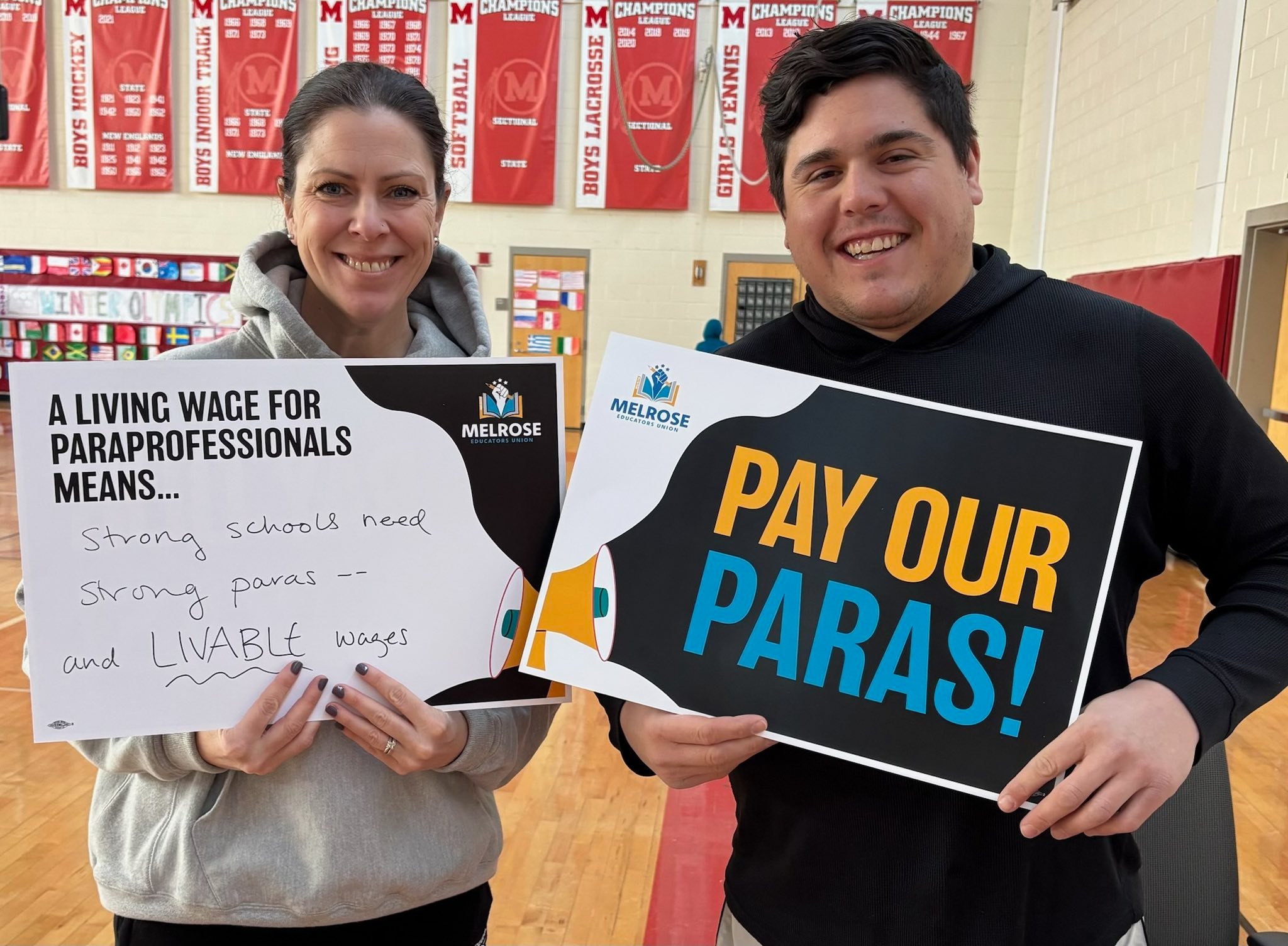
Photo From Melrose Educators Union
As the Melrose School Committee and the Melrose Educators Union work on negotiating new contracts this year, one of the issues that is under discussion is the situation of paraprofessionals in the district.
Paraprofessionals belong to Unit C of the Melrose Educators Union (MEU) and make up approximately 20% of educators in the Melrose Public Schools. Unlike classroom teachers, they do not need a teaching license, and they are also paid significantly less than teachers are.
Paraprofessionals fill a number of different roles, many of which are legally mandated, including as aides in self-contained special education classrooms and as support for students who require a one-on-one aide. They provide many different supports to students, ranging from academic support on assignments to social and behavioral support to physical support on tasks students can’t complete for themselves.
Why is the school district sometimes legally required to hire paraprofessionals?
Under the Individuals with Disabilities Education Act (IDEA), a federal law that was originally authorized in 1975 and expanded in 1990, all students are entitled to a free appropriate public education.
Students with disabilities who cannot access the regular education curriculum are legally entitled to an Individualized Education Program (IEP), which provides services that allow the child to receive an appropriate education. The school district is legally obligated to meet the conditions set out in a student’s IEP. If a service that is listed in the IEP is not provided by the school district, the student’s family can sue the school district.
If a student is not receiving an appropriate education in the Melrose Public Schools, they are legally entitled to an outplacement, paid for by the school district, which can cost as much as $100,000 per student per year - or more.
While some students with less severe disabilities might have less expensive services listed on their IEP - more time to complete assessments, tools like a screen reader, or weekly time with a special education teacher or a specialist like a speech therapist - students with more severe disabilities might need a one-to-one paraprofessional to support them.
“I follow the student I work with from class to class,” described one paraprofessional who works at the secondary level. “My student has the possibility for extremely disruptive behaviors, so I have to monitor and anticipate when those behaviors are coming - look for tiny signs that might spiral up, and deescalate him before he becomes disruptive. I help him with his work, I help him manage social situations, and I’m anticipating and heading off disruptive behaviors. If a teacher had to deal with this on their own, it would be next to impossible.”
In the youngest grades, some paraprofessionals are assigned to a classroom, rather than to a specific student, although this structure is much less common in general education classrooms in the later elementary and secondary grades.
“Five of the kids in my class are on IEPs for wildly varying reasons,” said one paraprofessional who works at the early elementary level. “For behavior, for academics, for emotional regulation, for delayed speech. I’m always watching the balance of the whole classroom, to see what’s coming to a boil, who's struggling, who’s frustrated, who’s discouraged. It’s all about watching and looking, working with the teacher, and figuring out how to handle this kid’s challenges or that kid’s challenges.”
“Since I started working in Melrose,” she continued, “the needs have gone up, and the challenging behaviors have increased. There’s a much higher chance of physical aggression, and you need to be mindful of that - I’ve been hit, kicked, and bit. It’s a tricky job.”
But while needs have increased, especially since the pandemic, educators also see students with disabilities being much more fully integrated into the classroom, allowing them to learn and socialize with their peers.
“When I first started, I saw students physically included in the classroom, but they had no interaction with their peers or with the curriculum,” reflected one paraprofessional who has worked in the district for two decades. “Now I, one hundred percent, believe that students are academically included in the least restrictive environment. We’re working on three pieces - physical, academic, and social inclusion. COVID did set us back, but every year, it gets better. But as paraprofessionals, we’re also expected to do more with no additional compensation.”
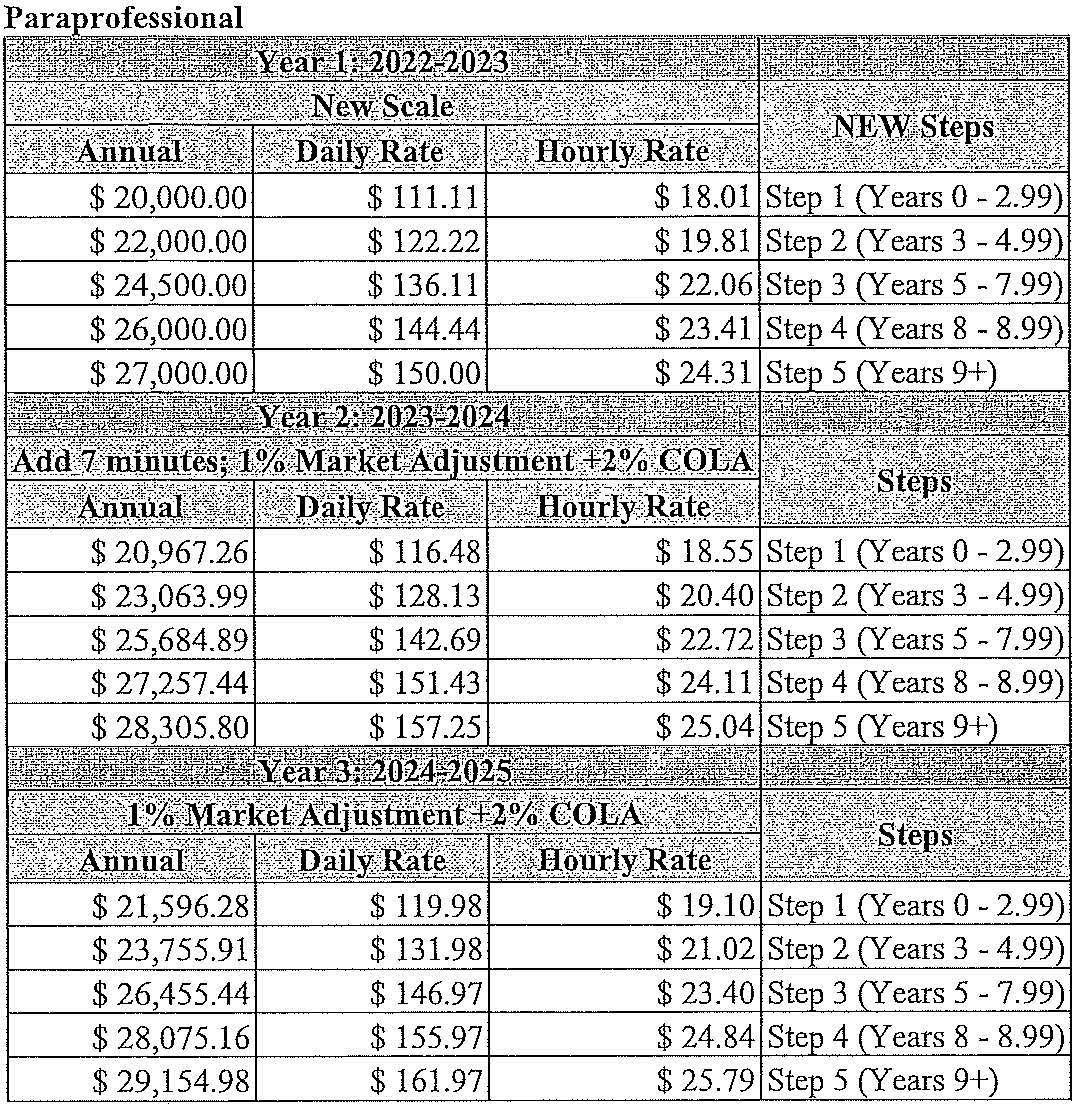
Pay scale from the current Unit C contract
Note that a one-year contract extension resulted in a pay increase
According to the current contract, a paraprofessional in their first three years of employment is paid $23,755 per year, or $21 per hour, and a paraprofessional with nine or more years of experience is paid $33,000, or $29.19 per hour. Currently, paraprofessionals are hourly, not salaried, employees, so they do not receive the paid time off that teachers do.
“The only reason I can afford to do this job for the pay I get,” said one paraprofessional, “is because I don’t rely on it for survival. It’s extra income for my family. If I had to rely on it for survival, I would need a second job - but this is already a pretty full-time job. We get to school at 8am and get home at 3pm - that doesn’t leave a lot of time for a second job.”
“We’re working at poverty level,” added another paraprofessional. “The schools provide us with health insurance, but we’re paid so little, we qualify for food stamps.”
“This was supposed to be a temporary job,” said one early-career paraprofessional. “I’m still here two years later because I love it, but the only reason I can afford to do this is because I live with my parents. I wouldn’t be able to do this on my own.”
Low pay for paraprofessionals is not an issue that is unique to Melrose, although pay for paraprofessionals in Melrose is lower than in any of our neighboring cities and towns. And while there is a shortage of paraprofessionals in many school districts across Massachusetts, districts that pay their paraprofessionals more are often better positioned to hire and keep them.
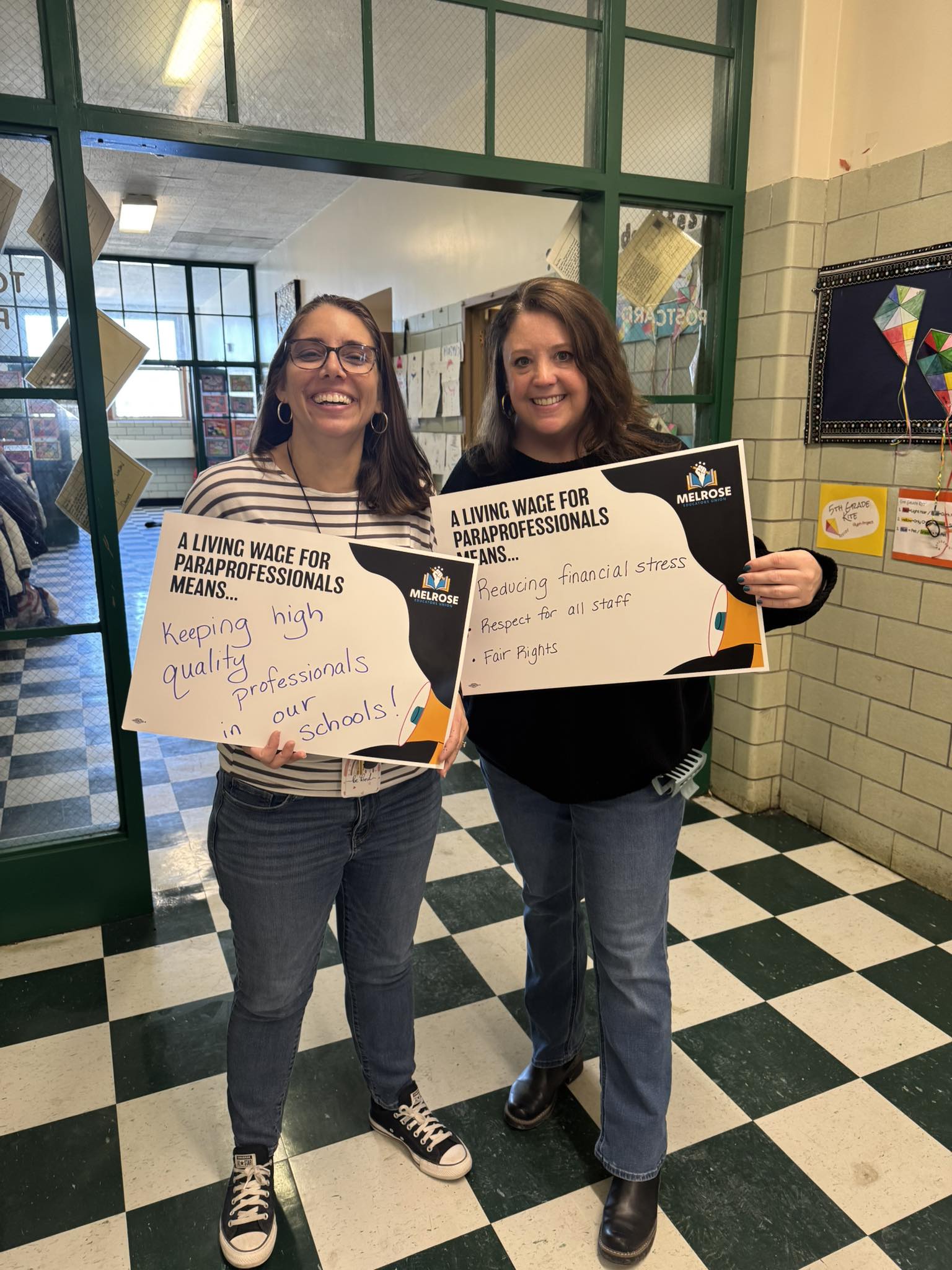
Photo From Melrose Educators Union
MEU President Leslie Means noted that, after Andover settled its most recent contract with paraprofessionals, with salaries $10,000 to $20,000 higher than those paid by Melrose, the district was able to hire for all of their open paraprofessional positions. “We could fill all of our vacancies if we paid competitive wages,” said Means. “It’s a numbers game. Andover is not far enough from Melrose to stop people from making that drive for better pay.”
In addition, paraprofessionals in Melrose do not have some of the contractual protections that teachers do. While teachers are entitled to lunch and a prep period during the day, paraprofessionals are only entitled to a single 15-minute break during the school day - which, due to the need for paraprofessionals to supervise lunch and recess periods, might not occur during lunchtime. And paraprofessionals are generally not provided with time during the school day to collaborate with general education or special education teachers, or even to read the IEPs of the students they support.
The school district is legally obligated to provide students with paraprofessional support if their IEPs state that they need that support. However, vacancies for paraprofessional roles, along with a shortage of substitute teachers that often has paraprofessionals covering classes, means that those needs are not always met.
Asked what they are hoping to negotiate in their new contract, paraprofessionals said:
- “A living wage.”
- “A full lunch block. I cannot eat my lunch in 15 minutes without practically choking. 25 minutes would be great.”
- “Paid vacations and holidays.”
“I sometimes feel that paraprofessionals are treated like the redheaded stepchildren of the district,” reflected one paraprofessional. “We’re overlooked and undervalued by the higher-ups.”
“We would love to see our paraprofessionals get to a middle-of-the-road salary, relative to the surrounding districts,” said Means. “We’ve made some gains, and it’s very frustrating that we haven’t been able to make more.”
“Being a paraprofessional isn’t seen as a job you keep,” reflected one long-time paraprofessional. “It’s seen as a job you move on from. I love seeing our paraprofessionals become teachers. But you need two kinds of professionals in education - teachers and paraprofessionals, not unlike how you need both doctors and nurses. But right now, we’re running out of nurses.”