MCAS Scores Raise Discussion About New Curriculum, Supporting All Students
By Ellen Putnam
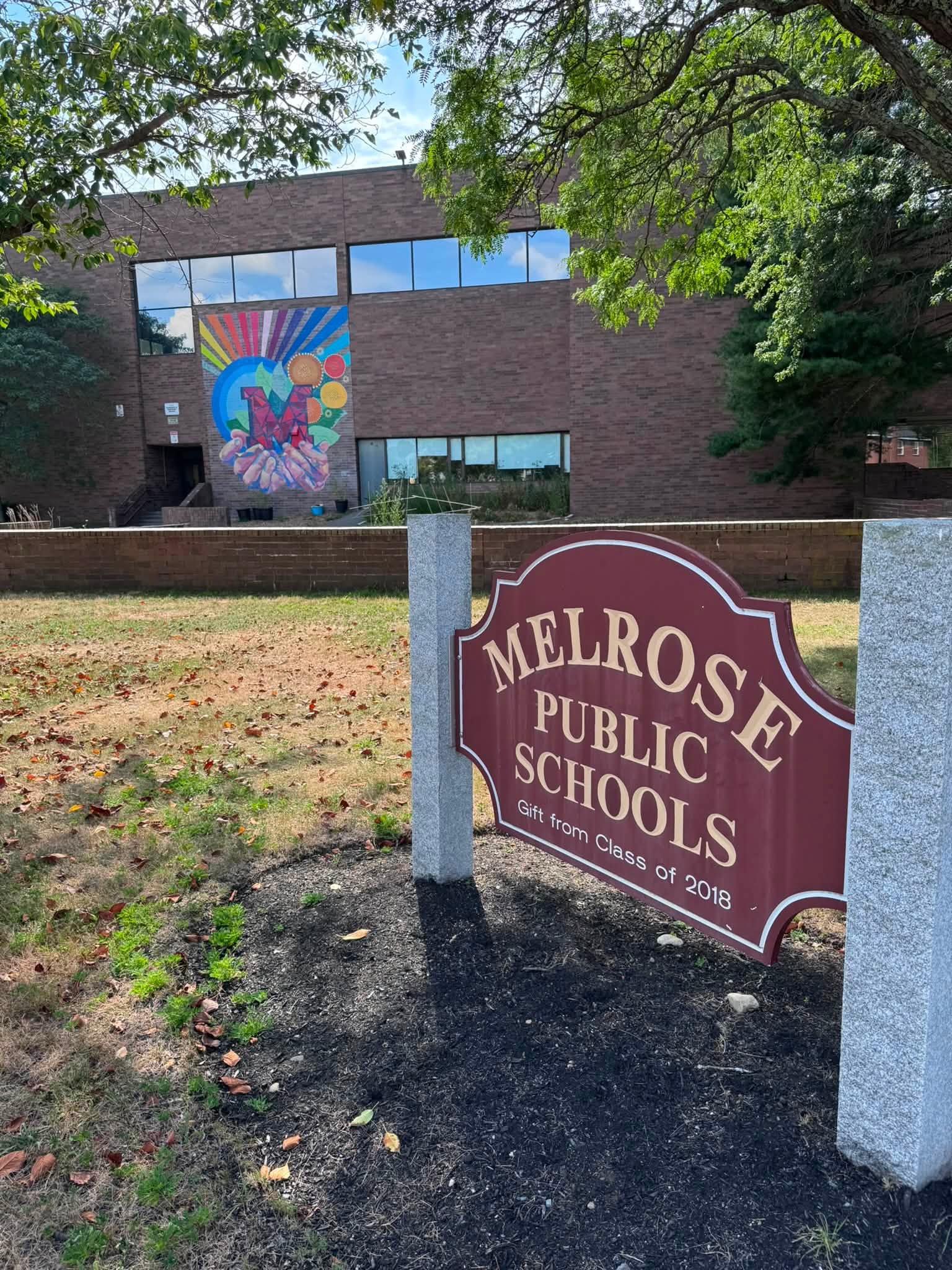
Photo Credit: Nancy Clover
This month, the School Committee reviewed state MCAS test scores for Melrose. While Melrose scored well relative to the state as a whole, the data highlighted a number of ongoing challenges that the district is working to overcome.
MCAS testing begins in 3rd grade and tests in English Language Arts (ELA) and Mathematics are given every year through 8th grade, and once more in 10th grade. Students also take tests in Science in 5th, 8th, and 10th grade, and Civics in 8th grade. Passing the 10th grade MCAS tests used to be a requirement for graduation until a 2024 ballot question (which was sponsored in large part by the Massachusetts Teachers Association) removed that requirement, although 10th grade students still must sit for the test. This year’s MCAS test was administered in the spring, and scores came out earlier in the fall.
What does an MCAS test actually look like? The state releases questions from past years, which can be found here. See the tests that students took this year in ELA, math, science, and civics.
This year, all seven of Melrose’s schools that take the MCAS test performed well above the state average (40% of students meeting or exceeding expectations). Melrose Veterans Memorial Middle School (MVMMS) performed the lowest of any Melrose school, with an average of 53% of students meeting or exceeding expectations; Hoover and Lincoln performed the lowest of the five elementary schools, with 62% of students meeting or exceeding expectations; and Horace Mann scored the highest of any Melrose school, with 80% of students meeting or exceeding expectations.
The Melrose schools that scored lowest on the MCAS test are also the schools with the largest population of High Needs students (defined as students who have a disability, are an English learner or former English learner, or are designated as low income).
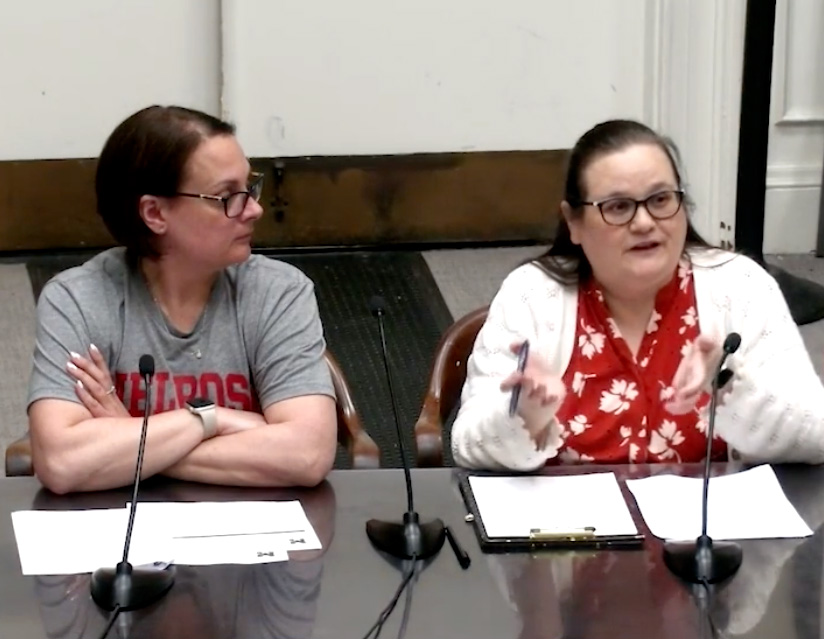
Asked at this month’s School Committee meeting about the reason for the lower scores at the middle school level, Melanie Acevedo, Executive Director of Academics and Accountability, noted that there is less overall time spent on literacy and math at the middle school level, although additional literacy and math blocks in sixth and seventh grade are intended to reduce that discrepancy.
Additionally, she reflected, “some of it is developmental. If middle schoolers don’t want to do something or don’t want to put forth their best effort, despite every educator standing on their head, they’re not going to. So how do we support them in the mindset of: everything is important, whether or not it’s graded?”
She also noted that the effects of the COVID-19 pandemic can still be seen among students at the middle school, who were in early elementary grades when schools were closed. And she observed that those students did not benefit from recent changes to early literacy in Melrose.
Melrose, like many other school districts, has recently embraced instructional practices known as 'The Science of Reading.' This is a shift from the 'balanced literacy' programs that were popular in many school districts from approximately the early 2000s through 2020, which deemphasized explicit phonics instruction in favor of focusing on meaning. Research has found that phonics instruction is important for struggling readers, including many students with disabilities.
Melrose has since added more phonics instruction to the curriculum for younger grades but, said Acevedo, “because of the shift in literacy practices at the elementary level, our current middle school students didn’t receive as much of that foundational skills phonics instruction, which is now showing up in later years because students who were able to fake it in reading and memorized enough words that they could get by are now encountering academic language that they can’t decode.”
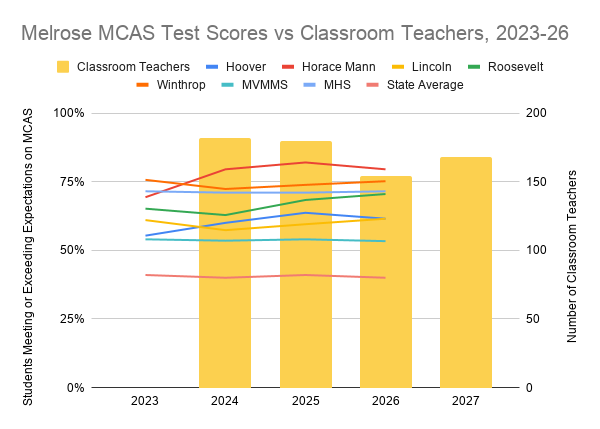
Melrose MCAS scores relative to total number of classroom teachers, 2023 to present
Despite the loss of 28 classroom teacher positions across the Melrose Public Schools between the 2024-25 school year and last year, Melrose’s MCAS scores mostly held steady, with some schools and grade levels seeing relatively small increases and others seeing relatively small decreases. (It’s important to remember that a student’s performance on an assessment like MCAS is the result of all of their years of schooling up to that point. For that reason, one difficult year is unlikely to result in dramatically lower scores across the district, just as one successful year is unlikely to result in a dramatic increase.)
Melrose voters passed a $13.5 million override last year, which allowed the schools to add back 17 positions. Those 17 positions included five elementary classroom teachers, eight secondary teachers, one elementary assistant principal position, and one secondary curriculum coordinator, as well as two student support positions shared across multiple schools. The budget flexibility created by the override also allowed the schools to return Steve Black, the district’s beloved Visual and Performing Arts Director, to that full-time position (last year he had been serving as an assistant principal at MVMMS) and create a position that is part-time assistant principal at the Winthrop School and part-time elementary curriculum coordinator.
As a result of these added positions, class sizes are now lower across the district, although many classes at the secondary level are still in the high 20's. Additionally, curriculum leadership, which was down to one curriculum director last year, has grown slightly, now with one part-time elementary curriculum coordinator and two secondary curriculum coordinators. (In the 2023-24 school year, the district had 12 curriculum directors, all overseen by an Assistant Superintendent for Teaching and Learning.)
“We are still lean,” district leadership emphasized.
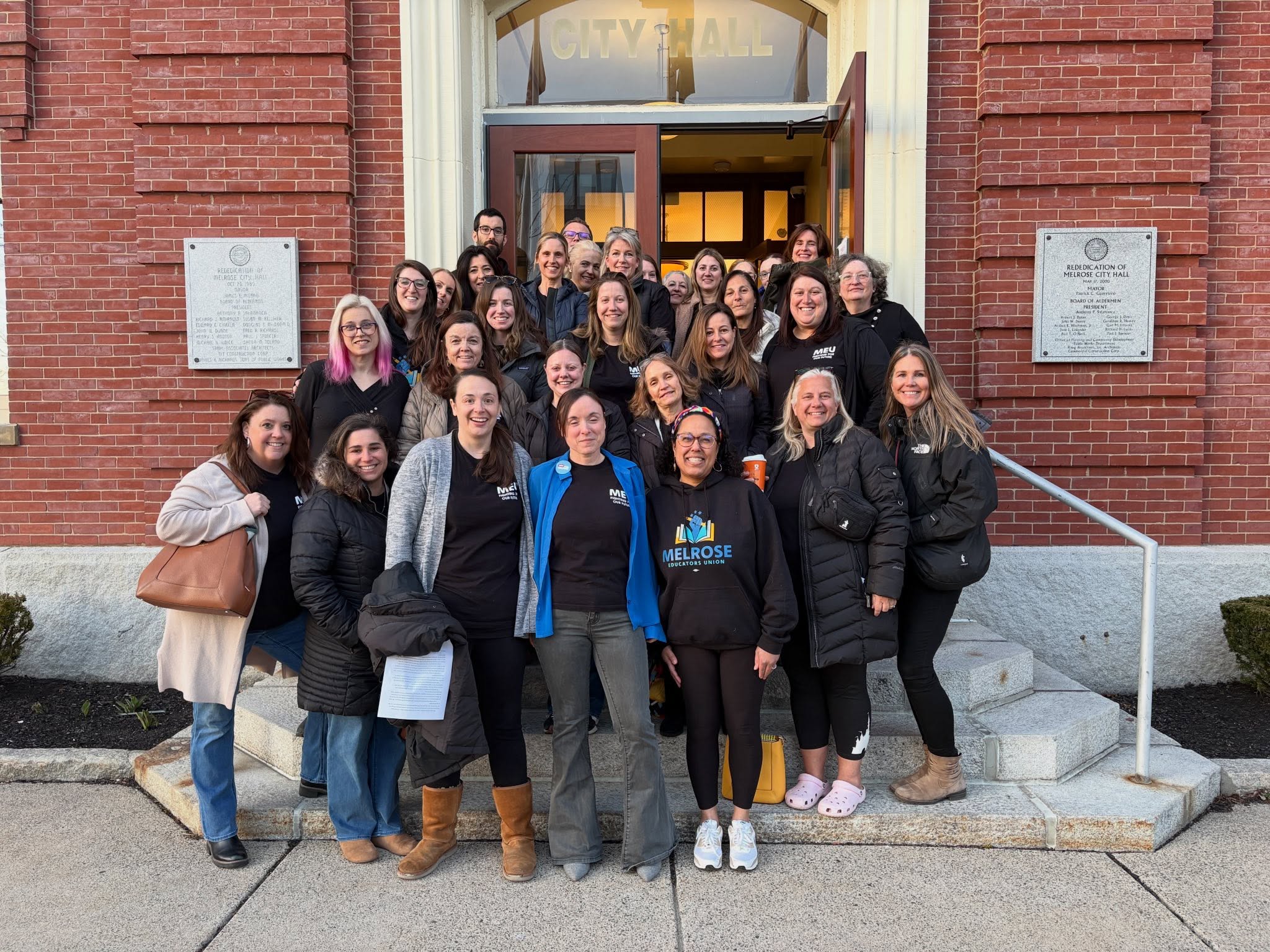
“We continue to be extremely relieved that the override passed,” said Melrose Educators Union (MEU) Vice President Joellen Beaudet, who teaches 5th grade at the Hoover School. “We were barebones, and we couldn’t afford to lose any more positions. But we are still understaffed, and we are still having a hard time filling positions for paraprofessionals.”
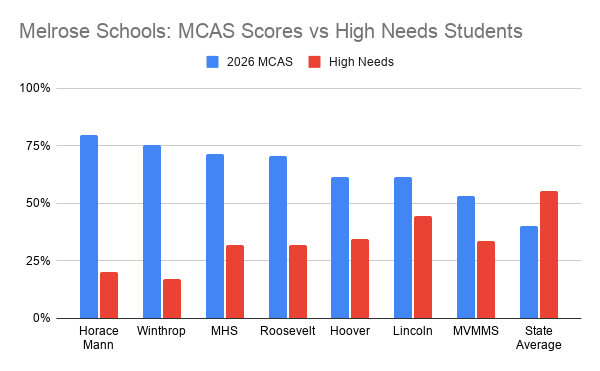
Percentage of students at each Melrose school meeting or exceeding expectations on the 2026 MCAS test relative to percentage of students at each school identified as High Needs
Nearly $1.5 million of override funds in last year’s supplemental budget went to purchasing new multiyear contracts for curriculum materials for the schools. This includes the Reveal math curriculum for all Melrose students, Kindergarten through Algebra II, which a group of Melrose teachers selected from among a few math curriculum options. Elementary teachers also recently began using the MyView literacy curriculum, and the program’s middle school counterpart, MyPerspective, was fully adopted this year. And the UFLI phonics curriculum was also added for young readers.
Acevedo suggested that new high-quality curriculum materials will provide consistency across schools and for all students. “The teachers have done an amazing job with their teacher-created units and lessons,” she said, “but the research shows that really having high-quality instructional materials is necessary for all students to have access to that high-quality curriculum.”
“The new curriculum is a heavy lift at the elementary level, especially for the K-2 teachers,” said Beaudet. “We’re excited, but a little overwhelmed. Everyone is doing our best, but it will take time to figure out which are the best pieces of the curriculum to use, and which will need tweaking and supplementing. We see the new curriculum as a positive change, and we’re hoping to turn around some test scores, but with the new curriculum, it will take a couple of years before the benefits can truly be seen. It’s not going to be a miracle cure, all at once.”
MEU President Leslie Means, who teaches 8th grade ELA, noted that the new MyPerspectives curriculum is the first time secondary ELA teachers are working with a ready-made curriculum instead of creating their own materials. “The middle school ELA teachers have become close collaborators over the 21 years that I’ve worked in the district,” she reflected, “and we make sure that students are leaving with the same experience - they all read Anne Frank and Romeo and Juliet and have the same assessments on the core texts. Now we’re having a hefty curriculum book put in front of us - with a lot of really great elements - but it’s jarring for a lot of us.”
“I’ve grown to appreciate a lot of the pieces of MyPerspectives,” Means went on. “It’s hitting standards that we sometimes miss, or don’t give full weight to.” But she noted that the curriculum is designed to be taught across more days than teachers see students in the year, even assuming that every student is moving at the same pace. “The goal this year is to do the program with fidelity, as much as possible,” she said, “with the expectation that, moving forward, we get to pick and choose which pieces work for us and which pieces need to be modified.”

MEU members distributing books to Melrose students at Victorian Fair
Photo Credit: Nancy Clover
The new curriculum arrives at the same time that many districts are reevaluating the role of technology in education, after many leaned into it, by necessity, during the COVID-19 pandemic. Concerns about students losing the ability to focus on their work due to screens, and the ease of offloading learning onto AI chatbots have led to cutting back on computer usage across the country, at all educational levels.
MCAS testing is still done on computers, and quarterly IXL testing is as well. But outside of testing, Means said that, at the secondary level, “We’re definitely trying to keep kids off screens. We’re really trying to get back to: don’t assign something on the computer if you can do it on paper. Don’t use the computer just because it’s there. A lot of our serious learning and thinking is being done on paper again.”
But with teachers aiming to teach the new curriculum with fidelity this year, Beaudet noted that this can cause a conflict between the goal of getting students off devices and following a new curriculum with digital components, including components that are aimed at tailoring instruction to a student’s level and helping them move forward. “We are making sure we are using all the components as we are supposed to,” she said, “but something doesn’t feel quite right about popping a kid in front of a screen instead of teaching the content. We hear that the program is adaptive, it’s supposed to do all the things it’s promised to close achievement gaps, but it’s hard to tell kids they have to spend class time in front of a screen when we as adults want to have more real-life interaction.”
Commentators have noted that the prevalence of standardized testing, which requires students to read short excerpts and answer questions about them, has led to declining attention among many American children for reading entire books. Beaudet and Means shared similar concerns, and Beaudet noted, “I find that when the Chromebooks are closed and kids are reading an actual book, their ability to persevere through something more than an excerpt is a muscle that just hasn’t been worked enough. As a literacy teacher, I miss sustained reading, where students read an entire book, not just a passage.”
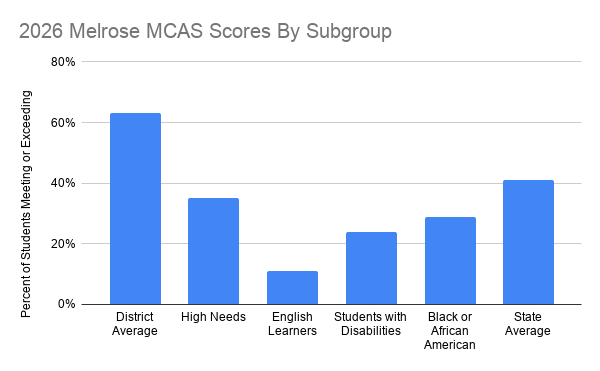
2026 Melrose MCAS scores by subgroup
All students are required to take the MCAS test, except for English language learners in their first year at a school in the United States, and students with the most severe cognitive disabilities (approximately 1% of students statewide, who take an alternative assessment).
In Massachusetts as a whole, students with disabilities, English language learners, and low income students, as well as Black students, all consistently underperform relative to the statewide average, and this is true in Melrose as well. This year, compared to an average of 63% of Melrose students meeting or exceeding expectations on the MCAS test, only 24% of students with disabilities, 11% of multilingual learners, and 29% of Black students met or exceeded expectations on MCAS.
Addressing the lower scores within these subgroups, Acevedo said, “I think that high-quality curriculum materials are a good first step in providing that access point for all students. But beyond that, we absolutely need to do more small-group intervention to catch students up and be proactive in addressing those challenges that we do know exist.”
“We now have a pretty firm rule that nobody gets pulled out of full-class instruction,” Acevedo went on, “so we are ensuring that every student, moving forward, gets high-quality instruction from their classroom teacher. This wasn’t the case historically: there were times in the recent past that we were so focused on remediating, we weren’t allowing all students to have access to grade-level standards. We can’t go back to the past and fix it, but we’re hoping that as we start to see the younger students grow into middle school, they’re able to have that foundation that they were not typically getting in the past.”
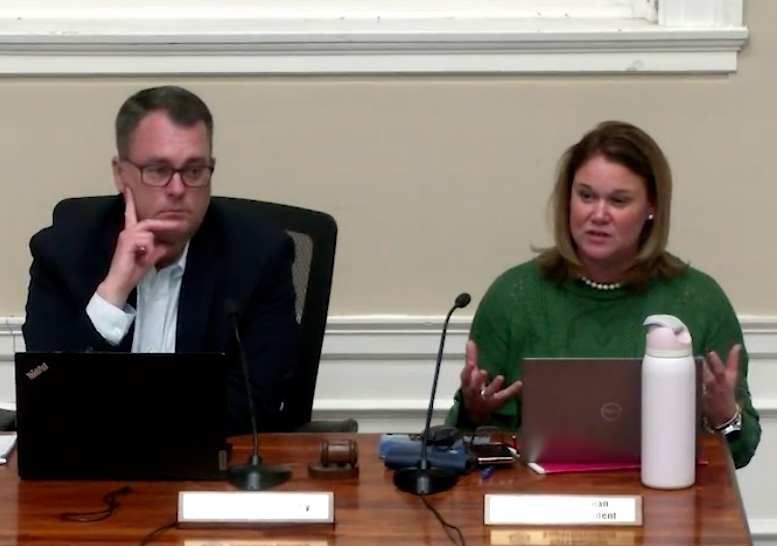
“All students deserve access to grade-level standards delivered by high-quality content specialists,” Superintendent Cari Berman added. “I have a very fond place in my heart for all of our special educators, but they’re not always content specialists. They don’t always know the content. So if we’re spending time on that remediation piece and students are not having access to what their non-disabled peers have access to, then they’re not moving forward, and they’re potentially falling further behind.”
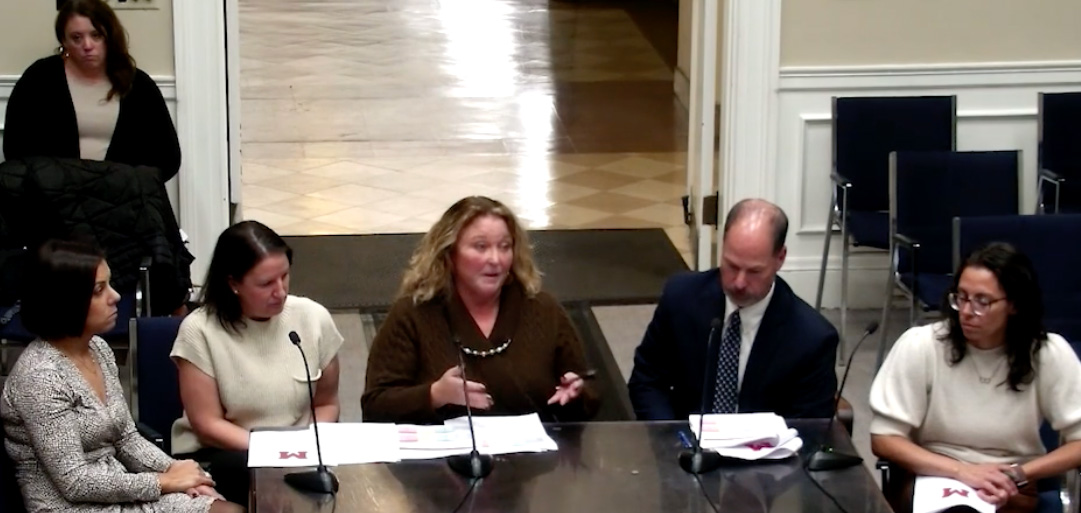
Left to right: Elementary school principals Vena Cruz (Roosevelt), Andrea LaCau (Franklin), Milissa Churchill (Horace Mann), Michael Tracy (Winthrop), Jessica Patti (Lincoln)
Screenshot from MMTV
Melrose’s elementary school principals presented their joint improvement plan this month as well, with the goal that 85% of students will make a full grade level of growth this year. Additionally, they aim to see 80% of students in the lowest 20% of test scores make a year and a half of growth, with the idea that working on catching up students who are currently behind will help them meet grade level targets, including proficiency on the MCAS test. The principals identified the new curriculum materials and targeted intervention blocks as the tools that will allow students to make that growth this year.
Similarly, the district’s joint special education coordinators, Linda Chase and Marc Kerble, see high-quality curriculum and targeted intervention as a way to reduce the number of students in Melrose who require special education services. They presented a report on the district’s special education program to the School Committee last month.
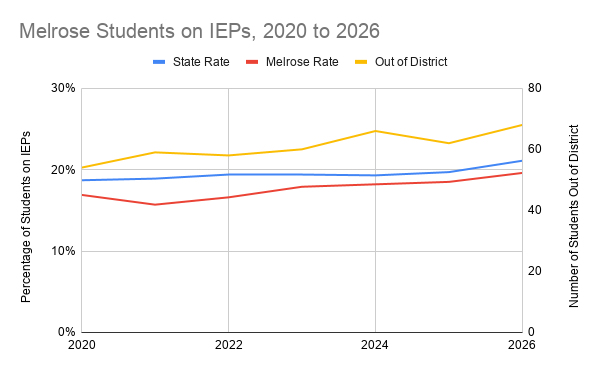
Melrose students on IEPs, 2020 to 2026
The number of students on Individualized Education Plans (IEPs, or plans that dictate special education services) has been steadily rising both in Melrose and statewide since the pandemic. Currently, 780 Melrose students, or 19.6% of the student population, are on an IEP. Over the last five years, over 1,200 referrals were made for special education, 63% of which were initiated by families (as opposed to by teachers). Only 41% of the parent referrals resulted in an IEP being created. “High parent referral ineligibility signals a critical need for clearer general education communication and enhanced small-group interventions,” Chase and Kerble noted in their data presentation.
“A lot of times we find that students are struggling and parents become concerned,” Chase noted, “And a lot of times what happens is the immediate thought is to refer the child for special education - and that means that the child has a disability. Sometimes when a child needs help, it doesn’t mean that they’re disabled. They just need help. And so we need to think about the other kinds of supports we can put in place.”
Melrose will be receiving some outside review soon as well. The Department of Elementary and Secondary Education will be coming to Melrose at the end of this month to review the core curriculum. “They will give us some feedback on our curriculum,” said Berman, “and I think that will be really timely and good for us as we talk about our strategic planning - having some fresh eyes come in.”