A Conversation with Mayor Jen Grigoraitis
By Ellen Putnam
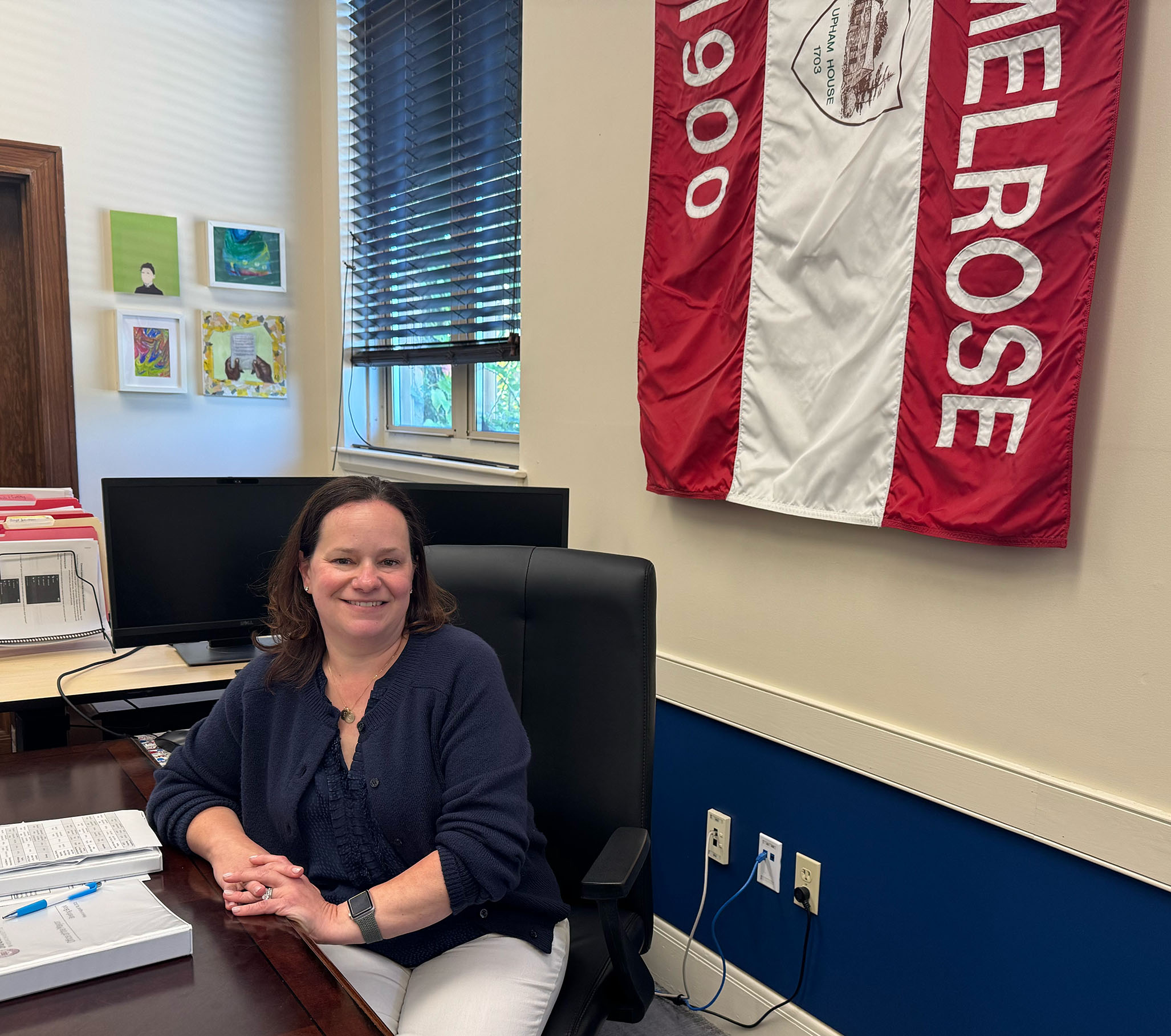
As Melrose winds down from another hot summer and municipal election season heats up, we spoke with Mayor Jen Grigoraitis about the topic on many residents’ minds right now: the three Proposition 2½ override questions that will appear on Melrose’s municipal ballot in November.
Proposition 2½, a statewide ballot measure that passed in 1980, prohibits cities and towns from increasing the total amount they collect in property taxes each year by more than 2.5%, plus some amount calculated to reflect new growth. According to the law, this limit can be increased by a property tax override for a specific amount that is approved by voters.
Melrose passed an override for $5 million in 2019, its first since 1993. Last spring, a proposed $7.7 million override was defeated at the ballot box, 55% to 45% (by 878 votes), in an election with 44% turnout.
This year (Fiscal Year 2026, or FY26), Melrose faced a $6.6 million deficit due to a number of costs rising faster than revenue is allowed to, and had to make significant cuts to services and positions in both the city and the Melrose Public Schools budgets. With another, similarly large (or possibly larger) deficit looming for FY27, Grigoraitis assembled a task force of city employees and leaders to decide on an override question or questions that would stabilize the budget and avoid further, more drastic cuts next year.
The task force came out with three tiered override questions: a state-approved but seldom-used approach where voters will be presented with three amounts: $9.3 million, $11.9 million, or $13.5 million. If one question receives more than 50% of the vote, that amount will go into effect. If more than one question receives over 50% of the vote, then the highest dollar amount that receives a majority of votes would go into effect. (It’s easy to see why this approach isn’t often used - it’s complicated!)
While much of the discussion of the override questions, in person and online, centers on Melrose’s current financial situation, Grigoraitis provided insight during our conversation into how this moment fits into our city’s larger history and trajectory.
“I feel really fortunate that since I took office, the five former mayors of Melrose who are still living offered themselves up as resources and supports,” said Grigoraitis, “and I’ve been able to get their historical perspective on the city.”
“Prior to the passage of Proposition 2½,” she said, “there was a lot more government in Melrose. There were more staff in the schools and in the city. Since then, we’ve seen a slow outsourcing of services because of the limitations of Proposition 2½.”
(One example: in a recent meeting, Fire Chief John White recalled that when he first joined the Fire Department, in the early 1980s, the Department had a dedicated mechanic for the city’s fire trucks. When the mechanic retired, that position went unfilled due to budgetary constraints, and the repair of fire apparatus was outsourced.)
“There are levers that mayors and City Councils have pulled throughout the years to try to squeak through the next couple of years,” Grigoraitis explained, “but if you flash forward, there are fewer of those levers left to pull. We regionalized services wherever we could. We pared back staff and we closed buildings - we have fewer schools now than ever. Everything is smaller now.”
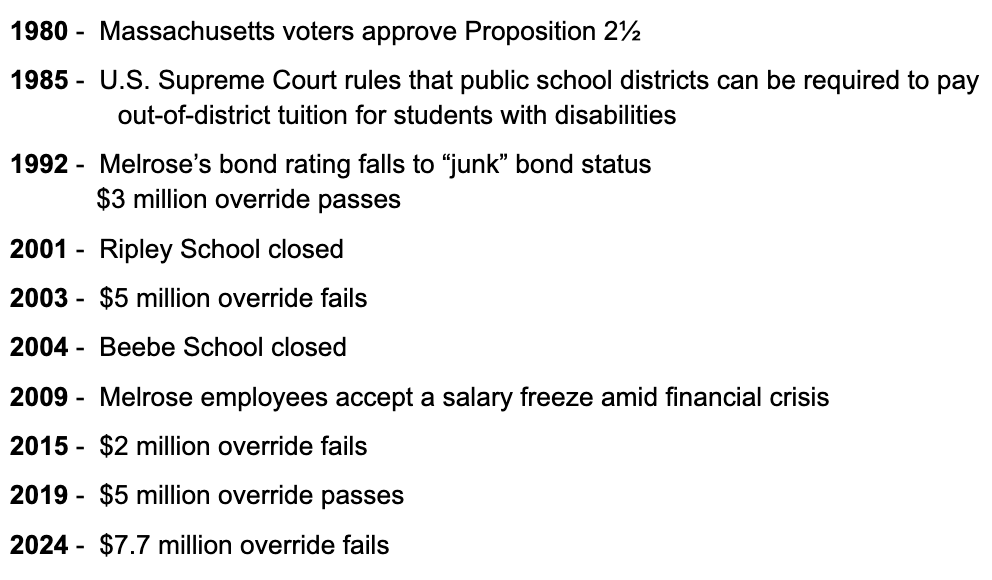
Grigoraitis noted that Melrose has been affected by larger economic forces in recent decades: the recession of the early 1990s, when the city’s bond rating briefly slipped into speculative grade or “junk” status; and the dot-com crash of the early 2000s, when the city closed the Ripley and Beebe Schools and briefly closed one of the three fire stations.
And then, in 2009, at the height of the financial crisis, state funding was slashed midyear. In order to avoid financial disaster, the city convinced its unions to accept a shift to cheaper health insurance with the state’s Group Insurance Commission and a wage freeze that capped cost-of-living adjustments at 1% for six years. “We could never do that now,” said Grigoraitis.
“It compounds,” she pointed out. “Our teachers, our police officers, our firefighters, our DPW staff, our city workers all took minimal pay increases for many years, but their cost of living has gone up like everybody else’s. We have done things to avoid an override, or because an override has failed, but those things have consequences and they leave us that much farther behind. And we’re out of market with our peer communities, which means that we lose people to other cities and towns.”
Although Melrose voters passed a $5 million override in 2019, the pandemic and accompanying financial shocks have led to the need for another now, in order to avoid further budget cuts.
“Six years between overrides,” Grigoraitis said, “there are communities for whom that’s a very standard stretch. But whether or not Melrose wants to be one of those communities is a decision for the voters.”
“COVID hurt us, but it also didn’t,” she explained. “Unlike communities that rely heavily on meals and lodging taxes and development, we didn’t see a major decline. We’re overwhelmingly residential in terms of our tax base, so in some ways we have less variability in our revenue streams.”
“There were obviously needs that were exacerbated by COVID, especially in the schools, that we needed to fund,” Grigoraitis continued. “The federal government did provide additional funding for all municipalities, but now that money is gone, and we had to pull back on things without that additional pot of money to help pay for those needs. We had added an Economic Development Director and a social worker, and we had to get rid of those positions last year. There just isn’t a broad enough appetite to fund those services.”
“Inflation rose during COVID,” she went on, “and while things have stabilized, they haven’t reduced, and we’re not back to pre-2020 levels for anything. We’re living in an environment where our mandatory costs are going up by double-digit or high single-digit numbers, but we can only raise taxes by 2.5%. You just can’t make that math work.”
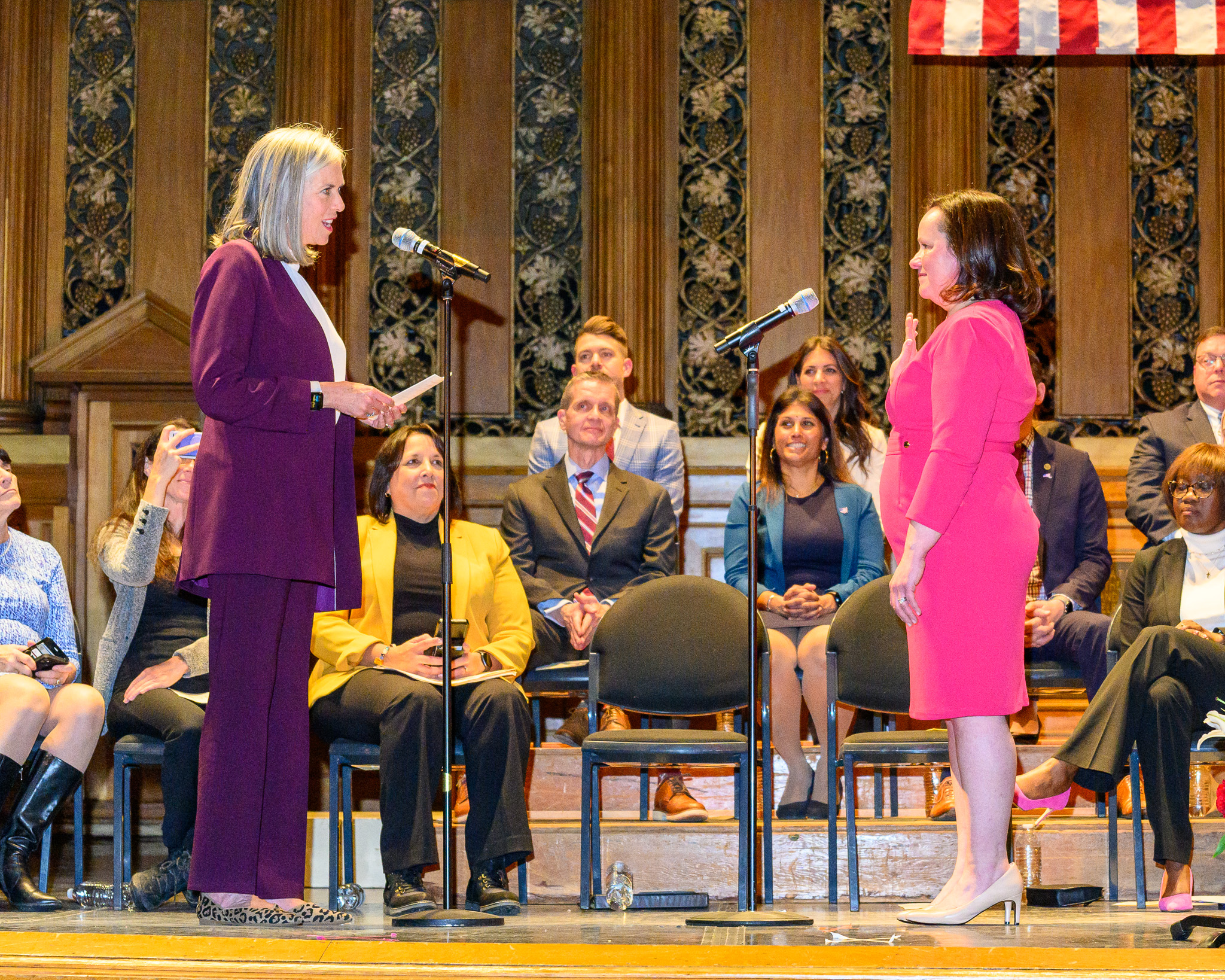
Mayor Grigoraitis is sworn in by Representative Katherine Clark in January 2024
Photo From the City of Melrose
While Melrose has weathered past budget crises, largely without passing overrides, Grigoraitis noted that there isn't much left to cut within the budget that hasn’t already been reduced.
“These budget crises tend to be cyclical,” she reflected, “and yes, we’ve weathered them, we’ve reduced services, but those effects carry forward. It’s cumulative, and that’s where we are now. What makes this budget crisis different is there are fewer levers left to pull.”
“I feel less confident that this trajectory is going to change anytime soon,” she continued. “Just look at the state and national picture: I don’t think a huge investment is coming from either of those places. The federal government doesn’t believe in it, and the state is going to be making challenging decisions about which holes they can afford to fill. We need to be captains of our own destiny at this moment in time.”
While the city’s revenue has been limited by Proposition 2½ and cuts to state and federal funding since 1980, legal mandates for what municipalities must spend money on have increased over that time period.
There have classrooms for students with disabilities in the Melrose Public Schools since the 1960s, but students with disabilities have only had the legal right to a free, appropriate public education (and all of the services that go along with that) since the passage of the Education for All Handicapped Children Act of 1975 (later renamed the Individuals with Disabilities Education Act - IDEA).
And in 1985, the Supreme Court ruled that school districts are required to pay for a student’s education out-of-district, including at a private school, if the student cannot be appropriately educated in-district and the out-of-district placement is determined to be most appropriate.
In Melrose today, out-of-district tuition and transportation costs (which are largely for students with disabilities or for other legal mandates, such as for homeless students) make up over 15% of the school budget (despite the fact that only 62 of the district’s 3993 students, or less than 2%, are educated out-of-district).
“We have so many costs that are our legal obligations in terms of educating children,” said Grigoraitis, “It is our great privilege to provide for them, but the costs are largely not determined by us. Increases in out-of-district tuition are set by state, and we just have to pay them. There was a recent year where tuition increased 14% in one year - now we’re at about 7% per year, on average. These are costs that we pay but we don’t set. They just get added into the budget and we have to figure out a way to reduce elsewhere.”
A number of other costs have also risen without input from the city. “Our pension obligation is significant,” Grigoraitis went on, “they are our retirees, and we have obligations to them. Just like health insurance, we’ve seen those costs go up, and they are not set by the city.”
“There’s tuition for students at the Mystic Valley Regional Charter School,” she added, “And Northeast Metro Tech has seen a massive increase in Melrose students going there, which is great, but it comes with increases in tuition.” This includes payments for the construction of a new school building, which will cost over $300 million in a combination of state grants and increased tuition costs.
“As we move through the fiscal year,” Grigoraitis concluded, “each time one of these agencies sets a rate, we input that data into our model. The things that Melrose does are the last things to get funded because those are the places where we have control, but there’s a smaller and smaller amount of pie for those things each year.”

Mayor Grigoraitis with Police Chief Kevin Faller at last year's National Night Out (an event that the Melrose Police Department was unable to hold this year)
Photo From the City of Melrose
While Melrose is not alone in its financial challenges, Grigoraitis noted that the city has yet to find a sustainable way to generate sufficient revenue to maintain government services in a post-Proposition 2½ landscape.
“There have been two ways in which communities in Metro Boston have generally approached Proposition 2½,” she explained. “There are communities who have said, ‘We’re going to regularly pass overrides and ask the community to put more resources into itself’ - communities like Arlington, Brookline, and Milton. And there are communities that have gone the growth and development way and have added office space and malls - Watertown, Wakefield, Burlington, Lynnfield, Saugus. And then there are communities in the middle, like Melrose, that haven’t really done either.”
“Development helps a little bit,” she added. While developers would be hard-pressed to find space in Melrose to build something like Lynnfield’s Market Street or even something like the commercial development that has gone up in Wakefield, new residential developments do count toward Melrose’s new growth calculation, which is exempt from Proposition 2½. New growth has generally hovered around $750,000 in recent years - useful, but nowhere near what is needed to fill a $6.6 million budget gap.
When the development that is now known as Windsor at Oak Grove (then called Oak Grove Village) - which is still the largest development in Melrose and one of its highest taxpayers - was built, “that put several million dollars in the budget,” Grigoraitis noted, “but it was hugely controversial and divisive at the time. It tore at the fabric of the community.”
“I don’t think there’s a solution that doesn’t come with challenges and disagreement,” she reflected. “I know everyone wants there to be one, but whatever we do, whether we cut services, whether we thoughtfully add development, or whether we raise taxes, there is always a group of people who feel it’s not the right choice. If there were a magic bullet, we would be putting it in place.”
Throughout our conversation, Grigoraitis emphasized that her administration’s goal in presenting the override questions to the community is to give residents the information they need in order to make an informed choice about our city’s financial future.
“What Melrose is going to be in three or four years is one hundred percent in the control of the voters,” she said. “I believe that it’s important to give people a voice and a choice, so you can help us know what you want to see in your community.”
While Grigoraitis noted that she did not anticipate, when she ran for mayor, that she would now be embarking a second override campaign in only her second year in office, she believes that putting the question before voters again - now that they’ve seen some of the effects of the cuts from FY25 and FY26 first-hand, both in the schools and in cuts to other city services like trash pickup - is the right thing for the city to do.
This current set of override questions reflects a different approach from last time. While last year’s failed override was derived from what the city and schools would need in order to fully serve students and residents, this year’s override questions are less ambitious. Instead, they focus on stabilizing cuts at FY26 levels and, at the higher levels, cautiously adding back some of the positions that were cut over the last two years (FY25 and FY26).
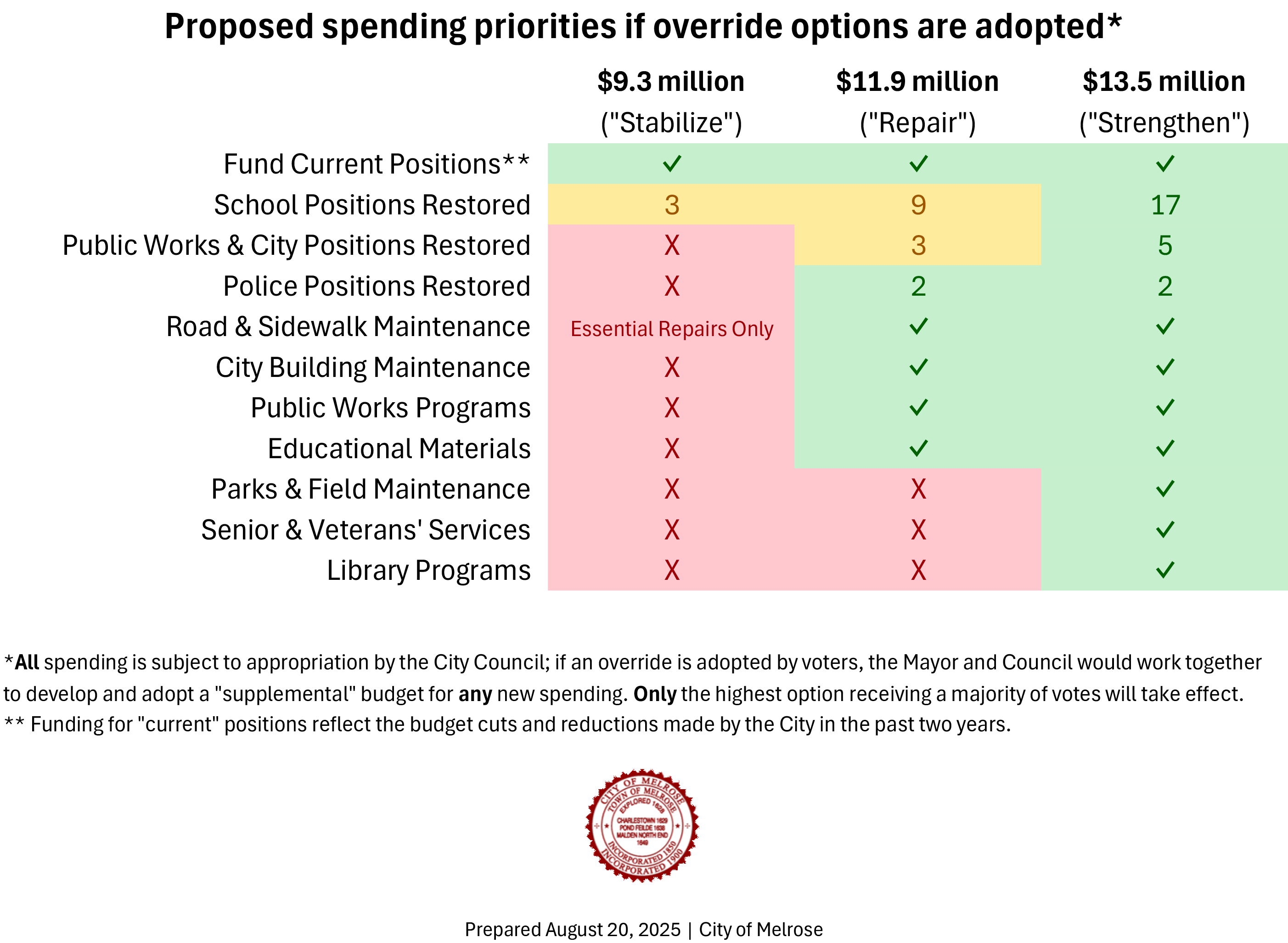
Chart explaining the projected impacts of the three override amounts on the city budget
Key to the idea of stabilizing the budget are detailed projections by city officials. If an override question passes, the city projects that it will be able to maintain funding at that level through 2030 without the need for additional funds before then.
“I give all the credit to (Chief Financial Officer) Kerri (Golden),” Grigoriatis said. “The job of the CFO is to manage the past fiscal year, the current fiscal year, and the upcoming fiscal year, and also to think forward, and to put time and energy and expertise into doing all of those things at once. Because of her work, we were able, as a task force, to think ahead three or four years. There are a lot of variables, and we don’t have a crystal ball, but we do have a lot of data to help us figure out where we think things are going to go.”
“We didn’t want to just say, ‘what have we lost?’ - we wanted to ask, ‘how do we maintain what we have?’” Grigoratis went on. “People are surprised by what it costs to maintain everything the city is doing. Next year, we will be negotiating with 10 of the city’s 12 unions - that’s hundreds of employees, and it will have a huge impact on the budget - and we’ve planned for that in these questions.”
The projection for each position in the budget includes cost-of-living increases and contractual increases that are predicted to come from union negotiations, as well as other costs like health insurance.
“We’re trying to provide stability,” she continued. “We know some folks would like to see us restore more positions, but because we go these long cycles without being able to increase our revenue streams, we have to project what it will cost to maintain what we have, because maintaining is expensive. We’re trying to be thoughtful and focused on: what can we bring back and maintain? We don’t want to bring something back without projecting out how those costs are going to rise year over year.”

Text of the override questions that will be on the ballot in November
From the City of Melrose
And what about those three questions, which have already spawned so much discussion (and some confusion)?
“Almost immediately after the override attempt last June,” Grigoraitis explained, “some of the feedback we were getting was that people wanted more of a choice. We heard from residents that they didn’t want a binary, all-or-nothing approach - they wanted more options. And in the listening sessions that we did earlier this year with the public and with the unions, we kept hearing the desire to see options.”
“Override ballot questions are heavily regulated by the state,” she went on, “and they provide cities and towns with a list of approved options. We spent a lot of time with the list, and we felt that the tiered approach matched what we were hearing from the community about choice. It’s definitely new, and new is scary, but we didn’t want to go back to the public with the same essential thing we keep doing - they felt we weren’t listening to what they were telling us.”
“The three amounts really derived from projections that the finance team is making,” added Communications Manager Tom Dalton. “They aren’t out of thin air. The task force was thinking about what it looks like from here to 2030, how to budget for those years. We don’t want to be in a position where the override is adopted, and in a couple of years, it’s like it never happened. The goal is to raise our total capacity and get on a better path, rather than being stuck.”
(It’s worth noting that none of the three override questions would restore all of the positions that Melrose had in FY24 - the task force projected that would require a $20 million override.)
While Grigoraitis emphasized that Melrose has no other viable options at present to raise the kind of money we need to avoid more drastic cuts in FY27, she is also collaborating with state leaders and other local leaders on making new options available for municipalities like Melrose at the state level. (Currently, cities like Melrose can only collect revenue in specific ways dictated by state law.)
“I am actively involved in conversations happening with mayors and town managers across Metro Boston and the state about what are viable alternatives,” Grigoraitis said. “It’s important for Melrose to have a voice in those conversations, but none of these things happen quickly.”
“So many other communities that are similar to us - and different from us - are also looking at overrides right now,” she went on, “and that is where we are in terms of rising costs. We are not the only school system that had budget cuts this year, and there is a heightened awareness among leaders that we need to have different conversations - but that’s going to be a longer term approach.”
“As the leader, it’s my job to present residents with options for right now as I work on options for years from now,” she concluded. “It’s a both/and approach. But we can’t neglect the present in the hope of something changing at some point.”
While Grigoraitis is personally involved in campaigning for the override, she acknowledges the burden that a tax increase is likely to place on some of Melrose’s more vulnerable residents, including seniors and people with disabilities.
“I’ve tried to make this central to my administration,” she said, “and the City Council has been a great partner on that, since so many programs require their vote. They have been supportive of making sure that we are leveraging all of the options that are available to us under state law.”
The programs that are currently available for residents who need property tax relief include:
- Deferred payment for property tax increases until property is sold or controlled by an estate. (This program is available for older residents, although it has income thresholds.)
- The property tax workoff program, where any resident who is 60 or older, regardless of their income, can work for the city and receive up to $2,000 in property tax abatement. (“We have great folks helping out in city offices, across departments,” said Grigoraitis, “Sometimes you’ll hear them on the phone if you call the Mayor’s Office.”)
- The senior circuit breaker program, where income-eligible seniors can receive a break on their property taxes.
- Property tax relief for veterans, which the City Council recently voted to expand through the HERO Act.
- The new Elderly and Disabled Taxation Fund, which was set up in 2018 but had not been staffed by volunteers until Grigoriatis enlisted residents - including former mayor Gail Infurna and former state representative (and current director of the AARP of Massachusetts) Mike Festa - to join this spring. (“It was important to me to get these things up and running,” Grigoraitis said. “It’s now fully staffed, and residents can apply starting this fall. It will be open not just to older residents - starting at age 60 - but also to those with disabilities, where there’s not always a lot of tax relief. It’s totally supported by resident donations - Melrose helping Melrose.”)
(Any Melrose resident who is concerned about affording their property taxes should contact the office of the City Treasurer/Collector by email at treasurer@cityofmelrose.org or by phone at 781-979-4120 to discuss what options could be available to them.)
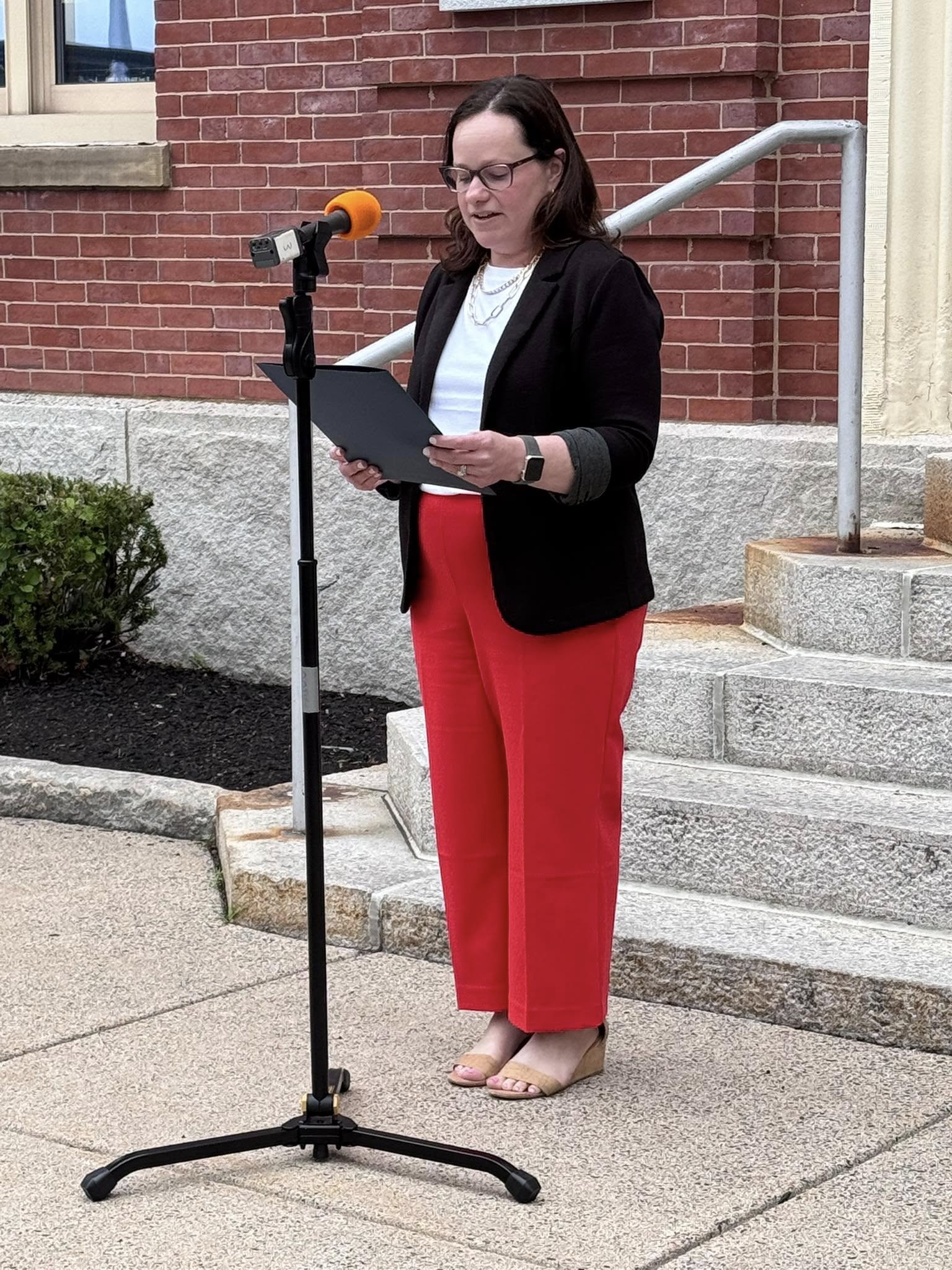
Mayor Grigoriatis speaking at the Juneteenth Flag Raising in June
Photo Credit: Nancy Clover
Grigoraitis also noted that the new Affordable Housing Trust Fund, which had also been created several years ago but had never been staffed, is now fully up and running. “The more we can put into affordable housing stock,” she reflected, “the more we can help residents be able to afford to continue living here in a different way.”
“And we need more diversified housing stock,” she added. “If someone is going to live their whole lifespan here, we need housing stock that allows for that. We can’t just be a community of million-dollar homes.”
“It’s been a big undertaking with the finance office, the City Council, our volunteers,” Grigoraitis concluded. “We’ve tried to put in place the broadest array of support for people that we legally can.”
Asked whether she sees some of our neighboring towns and cities as either examples or cautionary tales, Grigoraitis reflected, “Everybody has their own benchmark, but I think people should look at Milton, Stoneham, and Winthrop. They’re all close to Boston, they’re largely residential, and they have all in the past year put overrides on ballots that have had very different results. Look at what’s happening in those communities, at the conversations about school and city services.” (Milton passed an $8.8 million override this spring; Winthrop rejected a $5 million override last fall, before passing three override questions this spring that totaled a similar amount; and Stoneham rejected a $14.6 million override this spring.)
“Comparison is slippery,” she went on, “because Melrose is unique in Metro Boston. We are four square miles, seven miles outside of Boston, with three train stations, and we are over 90% residential. When you compare us to whatever you want us to be, do the digging: how is that community able to afford what you wish was here? They’ve either gone the growth route or the override route.”
“We cannot pretend that we don’t need more revenue in order to sustain services,” Grigoraitis emphasized. “I’m not sure people want us to just be a community that’s legally compliant. I want more from Melrose, and I think more residents do, too. We hear every day from people who want more from the schools, roads, public works, public safety, veterans services, Council on Aging, arts, events - and the city and school staff want to deliver that, but the reality of our budget constraints is that we can’t.”
“What we are so good about,” she reflected, “what attracts people to this community and makes them proud to live here and have their families here: it’s our beautiful green space, our thriving schools, our strong city services, our vibrant downtown. It’s a place people feel is this haven that they want to spend their lives in, and that’s what we’re always striving for.”
“Our goal is to be honest with the community about what we can afford and what services will look like within constraints of our budget,” Grigoraitis concluded. “This is about Melrose deciding what we want for Melrose. Nobody’s coming to save us - it’s really about people preserving our community.”