Elderly and Disabled Taxation Fund Will Provide Additional Form of Tax Relief for Eligible Residents
By Ellen Putnam
Photo Credit: Nancy Clover
The City of Melrose announced this week that it is now ready to accept applicants for property tax relief from the new Elderly and Disabled Tax Relief Fund. While the fund has existed since 2018 and has some funds available, this is the first time there has been a committee in place to manage and disburse the funds.
This news comes as residents prepare to vote, in November’s municipal election, on three property tax override questions that, if approved, would raise residents’ property tax burdens.
Property taxes are based on a home’s assessed value (which tends to be lower than its market value). According to the City of Melrose, the average assessed value of a single-family home in Melrose last year was $817,630. The owners of a home of that assessed value would currently be paying a little over $8,000 per year in property taxes. If the highest override amount passes, they would pay an additional $1374 for a total of approximately $9500 in property taxes per year.
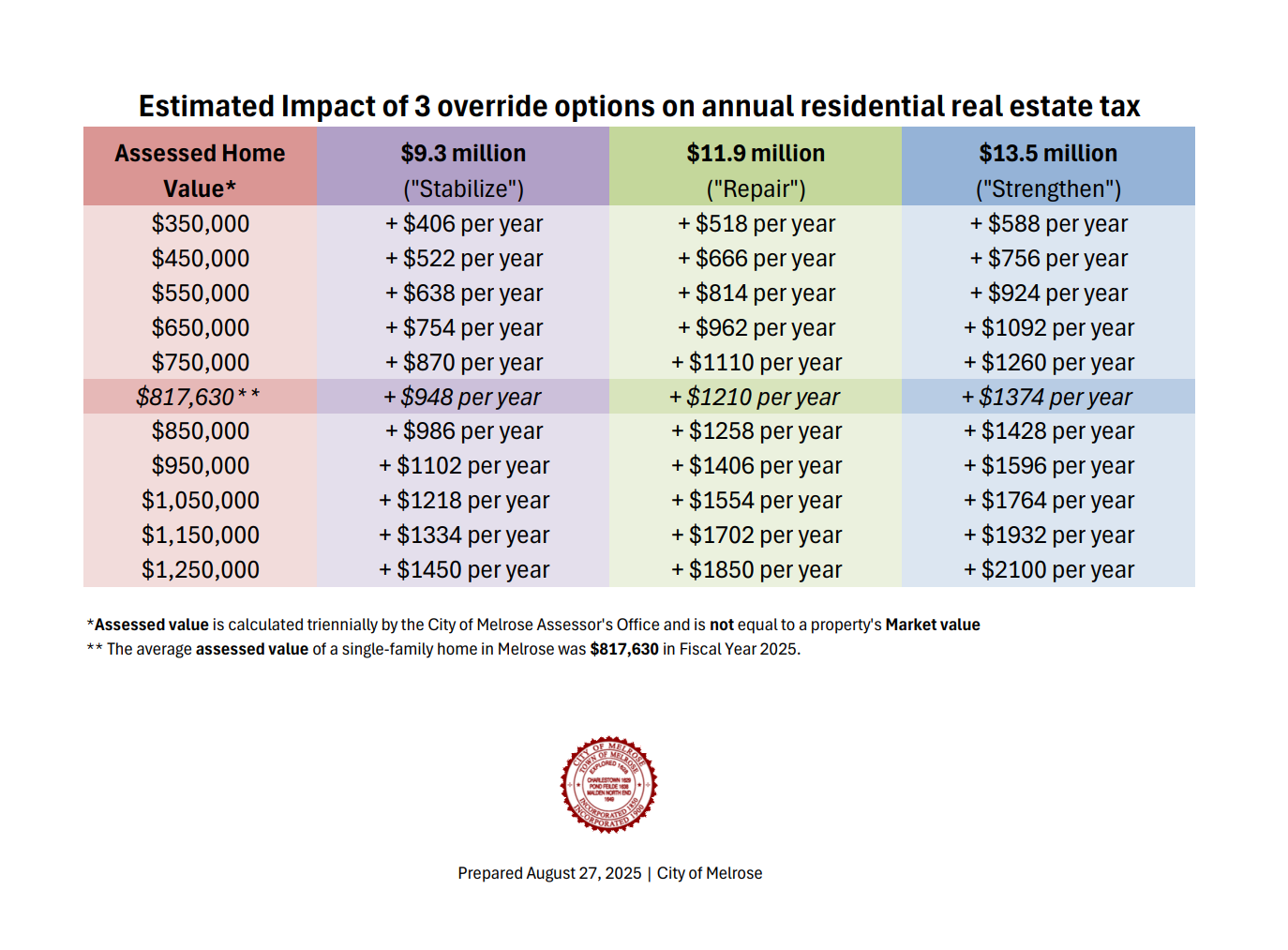
From the City of Melrose
While 63% of Melrose residents own their home, the impact of a property tax increase on renters is not as straightforward.
Approximately 4,000 units in Melrose are occupied by renters, and 550 of those are managed by the Melrose Housing Authority, which means that they are subsidized and will not be impacted by property tax increases. Some other rental units are affordable units, which means that rent is based on the occupant’s ability to pay. For many other rental units, landlords are likely to pass property tax increases down to their tenants, although landlords are also subject to market pressures in terms of how much they can raise rents in any given year.
According to the US Census, the median income for a household in Melrose is a little over $125,000. 3.7% of Melrose residents fall below the poverty line, although that number rises to 6.8% of residents 65 years and older. (A household with a single person 65+ is considered below the poverty threshold if they make less than $15,045 per year.) Over 20% of Melrose’s population is 65+, and almost 10% of the city’s population are identified as having a disability.
The city has a few different property tax relief programs that are aimed at homeowners who struggle to afford their property taxes. (Renters may be eligible for other forms of rental assistance from the state.)
Residents who are 65 and older and are low-income can apply for a property tax deferral, where they do not pay property taxes until they either sell their home or it passes to their estate, at which point the property taxes are paid from the proceeds of the house.
Any resident who is 60 or older, regardless of income, can participate in the property tax workoff program, where they can work for the city and receive up to $2,000 in property tax abatement. Last year, 49 residents participated in the program.
Although city staff aim to find a position that will work for each applicant, not all applicants are placed each year. This is sometimes due to a mismatch of an applicant’s skills and available positions; hours or responsibilities that don’t work for an applicant; or a lack of city staff who are available to supervise a program participant. While the workoff program does not currently include positions in the Melrose Public Schools due to licensing requirements and the need to coordinate with The Bridge, city officials hope to soon make it possible for program participants to take positions in the schools.
There are other programs available as well, including the senior circuit breaker program, which can provide a tax credit for low-income seniors, and a number of exemptions for veterans.
From the City of Melrose
The Elderly and Disabled Tax Relief Fund will now provide an additional form of tax relief of up to $500 per recipient for low-income seniors and disabled residents. According to the city, applicants must be 60 or older or have a documented disability, and should be earning less than $100,000 per year, with preference given to the lowest-income applicants. The total awarded from the fund depends on how much Melrose taxpayers donate.
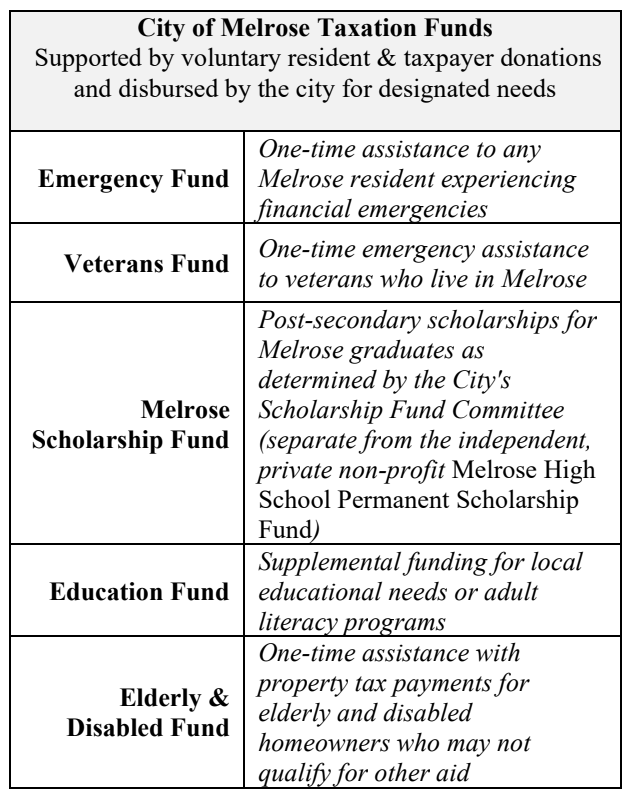
The Elderly and Disabled Tax Relief Fund is one of five voluntary taxation funds administered by the city. All of these funds are set up in accordance with state law, which is very specific about what can be done with each one. They are all funded solely by donations from taxpayers who choose to pay more on their tax bills or donate on the city’s website.
In addition to the Elderly and Disabled Tax Relief Fund, which was staffed for the first time this spring, Mayor Jen Grigoraitis also staffed the Education Fund so those one-time funds can be used to support the Melrose Public Schools, and the Scholarship Fund. The Veterans Fund is administered by the Veterans Services Advisory Board, and the Emergency Fund has its own committee.
“I’m very proud to activate this new resource for our low-income elderly or disabled neighbors and I hope that Melrose residents will generously support the fund by visiting the City website or when paying their next excise tax bill,” Grigoraitis said in a statement. “I am grateful to the Fund Committee for their work in opening this new and important resource in addition to our City’s other tax relief programs.”
Former mayor Gail Infurna, who is the chair of the Elderly and Disabled Tax Relief Fund Committee, said: “Although Medicare, Medicaid, Social Security and other state and federal assistance programs help so many people make ends meet, too many of our community members still fall through the gaps in these assistance programs and have a hard time making ends meet. Through the generosity of the community’s donations and with this program, we can directly deliver relief to members of our community who need it and who meet the established criteria.”